Top 5 IT Consultancies in Barcelona: Your Guide to Salesforce, Zoho, and Custom Software Development

Navigating ‌the ‌tech ‌scene in Catalonia hits with a rush sometimes. Barcelona sits as the main tech spot in southern Europe drawing nomads from afar along with big firms and top coders into the mix.

Scaling up though means cutting back on scattered tools or moving things to the cloud. A mere seller won’t cut it. What you want instead is someone reliable on the IT side to lean on. Build a fresh setup maybe get Salesforce going or tidy things via Zoho and the pick of consultant decides how much you gain back.

I will list the top five IT firms in Barcelona. These firms are changing how companies handle their technology.

1. ‌Nuvolar ‌Works: ‌A Benchmark for Custom Development and Salesforce Architecture

If I am to judge by engineering skill alone, clear communication, and digital change that actually moves the needle, Nuvolar sits comfortably at the top of the list.

Based in Barcelona, Nuvolar doesn’t fit the mold of a stiff, corporate vendor. They’ve earned a solid name internationally by sticking to a simple set of habits, put quality first, avoid shortcuts, stay bluntly honest, and bring real technical depth to the work. Plenty of agencies will throw together something prepackaged and ship it, then move on. Nuvolar takes the longer view, building software that scales cleanly and holds up over time.

Why Nuvolar Stands Out:

  • The “Working With” Philosophy: Instead of working next to your team, Nuvolar integrates seamlessly into your workflow. They operate as a proactive extension of your company, actively spotting technical debt before it becomes a financial drain.

  • Dual-Force Expertise: Nuvolar bridges the gap between complex Custom Software Development and elite cloud deployments. They specialize in heavy-lifting languages (Java, .NET, Node.js, Angular, React) while simultaneously operating as an advanced Salesforce Partner.

  • Niche Enterprise Mastery: They are globally recognized for structuring complex data layers in highly regulated, high-stakes environments—such as aviation enterprise data structures and custom health tech portals.

If your organization needs advanced business logic, custom APIs, custom UX/UI design, or specialized Salesforce configurations (like Experience Cloud setups or Apex/LWC development), Nuvolar delivers unmatched, clean-code excellence.

2. ‌Apps ‌Implantadores: ‌The Premier Zoho Premium Partner

If your company is already pulled toward Zoho, quick to adapt, budget-friendly, and built to work together across tools, Apps Implantadores is one name that keeps coming up. They’re based in Barcelona, and they operate like a serious force in this space.

They hold official Zoho Premium Partner status, and their focus is helping small and mid market businesses move from scattered tools to a fully digital setup. Zoho, in their view, isn’t merely email, it’s the system that runs day-to-day operations.

Why they deserve a spot on the list:

  • Full-suite rollouts: They manage Zoho One migrations end to end, pulling sales, marketing, finance, and HR, including Zoho People, into one shared view.

  • Strong feel for local processes: Linking Zoho CRM to Spanish invoicing and accounting needs is where they stand out, including automated tax workflows and billing connections.

  • Practical training: User adoption is a big priority for them, so your team doesn’t just get new software, they learn how to work with cloud-based automation in real terms.

3. ‌SEIDOR: ‌The ‌multinational built for enterprise scale

When the ask is a global tech overhaul, the kind that stretches across multiple countries and business units, SEIDOR is one of the big names that keeps coming up, with deep roots in Barcelona.

They work across the usual spread of classic IT infrastructure, but it’s their cloud consulting arm that’s been getting the spotlight. Most recently, they’ve picked up high-profile recognition for Salesforce work, including awards tied to their performance as a Salesforce Partner in the EMEA market.

Why They Make the List:

  • Global Footprint: Multiple offices across Barcelona, LatAm, and the US, plus the staffing to actually run multi-country deployments without collapsing under the weight of the rollout.

  • AI-Driven Customer Experience: Strong at connecting Salesforce Service Cloud and Marketing Cloud with advanced AI add-ons, so service and campaigns get smarter instead of just more automated.

  • End-to-End Enterprise Resource Planning: A good match for organizations that need to connect older ERP setups straight into modern CRM tooling, without ripping everything out at once.

4. HIKE & FOXTER: Specialists in data and revenue operations

HIKE & FOXTER runs as an independent Barcelona consultancy with a clear focus on data, design, and technology. Their sweet spot is where marketing tech meets serious CRM delivery, especially for teams that need both pieces to actually work together.

RevOps is at the center of what they do. The focus stays on aligning pipeline management, sales data, and automation targets, so revenue operations doesn’t become a set of disconnected tools and dashboards.

Why They Make the List:

  • Platform Customization: As certified Salesforce Partners, they go beyond setup. They build custom automation through Flow Builder and Apex, aiming to reduce process breakage and day-to-day operational mistakes.

  • Omnichannel Visibility: They put real effort into a proper 360-degree customer view across Sales Cloud, Service Cloud, and the outside channels where conversations actually happen.

  • Data & Analytics Alignment: Solid capability in linking migrations and system changes back to performance measurement, BI, and the metrics leadership cares about.

5. Millennials Consulting: Agile CRM integration without the drag

Millennials Consulting closes out the list as a nimble tech firm that’s earned a distinct spot in Spain by working comfortably in both Salesforce and Zoho environments.

They’re a practical fit for growing companies that want cloud systems set up quickly and cleanly, without the long, heavy project timelines that tend to come with older, larger providers.

Why They Make the List:

  • Dual-CRM Flexibility: With certified people across more than one CRM stack, they can give a clearer view on whether Salesforce or Zoho is the better match for your budget and how you actually operate.

  • API & Third-Party Connections: Efficient at midmarket integrations, tying standard cloud platforms into the tools teams use every day, from comms to e-commerce to project management.

  • Fast Time-to-Market: They’re built for tight deployment cycles, which suits fast-moving scale-ups landing in the Barcelona tech scene.

Final Thoughts: Picking the right Barcelona tech partner

A good IT consultancy shouldn’t feel like a detached vendor line on a spreadsheet. When it works, they operate like a strategic extension of your team.

For a cost-conscious, quick CRM setup geared toward local execution, Apps Implantadores or Millennials Consulting are worth a look.

If you’re dealing with enterprise size and cross-border infrastructure needs, SEIDOR brings the corporate reach and delivery capacity.

And if what you want is a top-tier team that combines serious custom engineering with high-level Salesforce architecture, while keeping communication clear, direct, and genuinely transparent, Nuvolar still stands out as the Barcelona benchmark.


What does AI Consulting look like for complex enterprise change?

Most ‌companies ‌are ‌using AI by now. Still, a lot of people miss the quiet part: plenty of those efforts don’t make it. And when an AI initiative collapses, it’s usually not because the model wasn’t “good enough.” The trouble shows up earlier, and it’s more basic, the goal is fuzzy, data sits in disconnected pockets, and nobody has spelled out how the output will land inside everyday work.

That’s where AI consulting earns its keep. Done well, it isn’t hype or a slide deck full of buzzwords. It’s a disciplined way to tie AI to real operations, policies, existing systems, and outcomes you can actually track.For mid-market and enterprise teams, the real issue isn’t whether AI can do something impressive. It’s whether it can do something useful, repeatedly, inside a business that runs on legacy platforms, regulated workflows, and a constant tug-of-war between priorities.

Which leads to the question that keeps coming up:

What does AI consulting actually means?

At its best, AI consulting blends strategy, architecture, delivery, and change management into one coherent effort. It helps an organization decide where AI belongs, how it should be introduced over time, and what has to change to make it stick. AI isn’t a standalone product you “install.” It touches data quality, integration, workflows, security, governance, and adoption. If a consultant only talks about models, they’re covering a small slice of the actual work.That difference matters, especially for executive teams. A prototype can generate excitement fast, but production AI is not a science fair project. It needs operating logic. Who owns the process? Where does the output go? What system receives it? How do you monitor accuracy and drift? Those questions aren’t paperwork, they’re where risk hides, and they decide whether AI becomes an asset or a liability.

Why enterprises need AI consulting now?

The push to “do something with AI” is real, and so is the price of charging ahead without a plan. Companies are being asked to cut manual effort, boost efficiency, improve forecasting, and get more value out of their data, often while upgrading core systems at the same time.

In sectors such as healthcare, life sciences, insurance, transportation, and financial services, the margin for error is narrow. Decisions affect compliance, customer trust, and operational continuity. A generic AI rollout often misses this context. A strong consulting approach starts by understanding the process itself: where friction exists, where decisions are repetitive, where data is underused, and where human judgment still needs to remain central.

That is why the strongest AI programs do not begin with a model choice. They begin with a use case portfolio and a delivery roadmap. Some opportunities are ideal for automation. Others are better suited to decision support. Some should wait until data quality improves or systems are integrated properly. At Nuvolar we adhere these best practices and we know that Good consulting brings that clarity early, before budget and credibility are wasted.

Where AI consulting creates the most value

Meaningful AI outcomes usually come from focused use cases. In sales and service, AI can improve prioritization, case routing, guidance, and forecasting. In operations, it can help detect anomalies, optimize workflows, classify documents, and reduce cycle times. In regulated environments, it can support monitoring and pattern detection while keeping human review in place.

At Nuvolar, we are committed to using AI in a sustainable and responsible way. Check out our AI services

Strategy is only credible if delivery is part of it

Many organizations have already done the workshops, the assessments, the “opportunity maps.” Those can help, but too often they stop right before the part that counts. Strategy without execution leaves you with a polished roadmap and no operational movement.A better model ties advisory work to delivery from day one. That means getting specific early: what data sources will be used, what integrations are required, what workflows have to change, and what the platform impact is for each use case. If insights need to appear inside Salesforce or another core system, the design should reflect that immediately. If users will need confidence scores, audit trails, or override controls, those aren’t “later” features, they belong in the first version.

This matters most in enterprises with complex digital environments, honestly, it matters for any size company.

The value is often less about raw “intelligence” and more about how well that intelligence is embedded in the tools people already work in. A model that lives outside the workflow can look great in a demo. A model that reduces handling time inside the real workflow changes performance.Governance doesn’t slow AI down, it makes it usableGovernance often gets treated like a brake on innovation. In enterprise settings, it’s the opposite. Without governance, most AI stays stuck in pilot mode because nobody feels safe scaling it. Effective consulting brings governance in early: access rules, privacy controls, monitoring, traceability, bias review, and clear decision rights. It also requires being direct about when human oversight is non-negotiable.

Important: Governance isn’t an add-on

Many mistakenly see governance as a hindrance to innovation. In enterprise settings, it’s the opposite. Without governance, AI is stuck in pilot mode due to a lack of confidence to scale. Effective AI consulting addresses governance early on, including data access, privacy controls, model monitoring, traceability, bias review, and clear decision rights. It also means being honest about when human oversight is mandatory. Governance isn’t an afterthought, but a key part of the design, especially in sectors with regulated records, sensitive customer interactions, or clinical and financial implications. The result is faster and fewer surprises. With proper governance, teams know which use cases are suitable, what controls are required, and how performance will be reviewed over time, creating a responsible and commercially sound path to scale.

The next and most important thing is:

The data question cannot and should not be avoided

All events, speeches, and articles will discuss how data inconsistency is a problem in many companies and how to solve it. In other words, problems with enterprise AI are usually caused by problems with the data. Having a lot of data doesn’t automatically mean that the information is accurate, organized, or useful for making decisions. Records might be spread across different platforms, tools, and applications with different definitions and owners. Consulting that ignores this reality often makes promises that it can’t keep. Effective AI depends on three things: context, quality, and availability. If customer data is duplicated, operational events aren’t standardized, or historical outcomes aren’t well-labeled, the model won’t perform well and won’t be adopted. AI can’t wait for a perfect data estate. This means that the work should be planned in a smart way. Some use cases can move forward with specific data preparation and limited process boundaries. Others require improvements to the basic structure first. Experienced consulting helps organizations deal with these issues instead of pretending they don’t exist.

How to evaluate an ai consulting partner

The right partner connects what leadership wants with the technical work that makes it real. They need to understand business value, platform architecture, user experience, and what happens after launch, not just how to build a model.In complicated sectors like aviation, healthcare, manufacturing, and finance, one-size-fits-all doesn’t hold up. AI should match the operational logic, compliance obligations, and approval chains of the organization. A good partner won’t inflate the scope just to make a bigger project, they’ll be transparent about readiness and help shape a plan that’s realistic and high-impact.This is why Nuvolar positions itself as the right partner. The difference is the combination: strategic guidance, strong data and AI depth, platform knowledge, and delivery capability in a single model. Instead of splitting responsibility across separate consultancies and technical agencies, Nuvolar aims to help enterprises scale securely and compliantly from the start.

So how does this look in practice?

Strong AI consulting brings focus. It aligns stakeholders, defines realistic use cases, and turns technical possibility into business design. It also prepares the organization for the unglamorous work that decides whether AI lasts: governance, workflow integration, monitoring, and operational ownership.The most effective AI programs rarely look dramatic. They start small, a few high-value use cases, real workflows, clear controls, and then expand based on evidence. Over time, that creates something sturdier than experimentation. It creates technology with intention.If you’re considering AI, the best question usually isn’t what the newest model can do. It’s where intelligence can remove friction, improve decisions, and strengthen the systems the business already relies on.

That’s what AI consulting should help you do well.


Check us out on Youtube

8 Digital Transformation Strategy Examples

The ‌conversation ‌around ‌real transformation tends to start after a CRM rollout flops, spreadsheets patched together and three teams each defining the same customer their own way, we have all seen this sort of thing. Leaders searching for digital transformation strategies want patterns that lower risk, set priorities straight and tie technology choices to business results one can actually measure. Nuvolar works on exactly that, backing leaders through those decisions.

Strong strategies grow from business friction, slow service delivery or poor visibility, inconsistent data, compliance pressure, systems that fail to support growth, rather than trendy tools, even if some think otherwise. That is why the most useful examples show how companies align their operating model with platforms, people and governance, software selection aside.

What strong digital transformation strategy examples have in common

Transformation ‌strategies ‌that ‌work across fields often start from the same place. A real operational issue sits at the core, not some loose idea about updating everything. You figure out exactly what you need and want right away. Then comes pinning down what improvement actually means on the ground: things like faster cycles, better data, more people using the system, less manual work, forecasts you can trust, or rules followed properly. Trade offs get spotted before they bite.

You push for speed yet skip the checks and end up fixing things twice over. Standardizing helps things grow but push too hard and key processes snap. AI boosts how much gets done, sure, provided the data underneath holds up. Strong plans lay those choices out in plain sight.

 1. CRM consolidation to create a single commercial operating model

Commercial ‌fragmentation ‌sets ‌most digital transformation efforts in motion, and the same pattern shows up in company after company. Sales sticks with its own system, service clings to another, operations patches gaps using spreadsheets that nobody quite believes. Records duplicate without end. Processes clash from one department to the next.

What comes next surprises nobody, users stop trusting the data, reports give only half the picture, customers feel the mess even when they cannot put a name to it.Moving everyone into a single CRM fixes little by itself.

A real strategy reaches further, it reshapes how leads move forward, decides who owns accounts, reworks service workflows, and chooses the numbers leaders actually track. Teams must settle the basics first. When does an opportunity count as ready? How does one log a call, an email, a complaint? What figures reach the executive dashboard, and why those figures?

The value is not simply better visibility. It is a commercial model that scales. For enterprise and mid-market organizations, especially those [using Salesforce or Zoho](https://nuvolar.com/picking-the-right-salesforce-consulting-partner-for-your-business-a95ba2585cc4/), this approach can improve forecast accuracy, reduce handoff failures, and give revenue leaders a more credible operating picture.

 2. Workflow automation in compliance-heavy environments

In ‌sectors ‌heavy ‌on rules, from healthcare through insurance and on to aviation or life sciences, change often kicks off right where snags meet the weight of oversight and compliance. Approvals stack up by hand; papers get hunted down from one team to the next; records of checks sit apart, unlinked. Things slow down, and risks grow.

A better route opens up when automation of flows gets built with oversight right from the start. Instead of just layering new systems over broken steps, groups map out choices first, lock in what must be controlled, then set auto skips where rules allow. Routing for signs off, handling of cases, checks on papers, all get formed so that pace and responsibility stay together, neither lost to the other.

Success or stall often hangs on this point. Push only for quicker steps and watch the compliance side push back hard. Load too many checks in and people slip around them, finding side paths past the setup you planned with care. The steadier choice makes oversight feel natural inside how folks work day to day; not added later as an extra gate, not a separate stop. It becomes the way the tasks move along.

3. Data unification for operational clarity

Many ‌organizations ‌wind ‌up with dashboards everywhere yet few choices actually taken from them. Data sits split across ERP platforms, CRMs, support tools, finance systems and departmental trackers; leaders argue over whose figures hold up instead of moving forward with them. Clean consistent data remains the only workable path when AI enters the picture. Building one shared data setup around core decisions counts among stronger moves in shifting how firms handle information.

Aligning customer records, product details, claims, patient files, supplier info or service entries across tools lets teams draw from a single reliable picture. Tying that effort to a concrete result makes the difference. Improved service plans, clearer margin views, demand forecasts or executive reports push adoption further than any broad push toward data use alone. When changes link straight to choices people make daily, uptake rises and the case for spending holds up easier.

4. Legacy modernization through phased architecture change

Because ‌big ‌replacement ‌efforts stumble when they overhaul all at once organizations holding onto old systems embedded deep find more sense in gradual updates. Not to keep things tangled on purpose though but to cut down risks in daily work and open space for real gains instead.

Take how teams might pull apart the parts customers see or the workflows that eat up time from the old heart of things first like those custom builds at https://nuvolar.com/service/custom-software-development/ .

Then they get to shape new front ends; smooth out steps automatically pull info together without touching the whole back side right away. Choices on structure grow more thoughtful as days pass less driven by panic. Patience and steady hands become necessary here.

On paper the step by step way drags a bit yet it brings quicker wins in practice by dodging the chaos of swapping everything out. Many big company setups see this as the route that holds up better.

5. Customer experience transformation across channels

Customers ‌often ‌expect ‌more consistency than companies can deliver across web email phone field teams and self service channels. Yet those paths usually sit with separate departments each running its own tools and metrics.

A solid transformation approach traces the full customer path spots the weak spots then pulls systems and teams together around the key moments that count. That alignment might cover things like case routing customer identity service history knowledge access or personalized communication all the bits that tie it together.

The case for change goes past satisfaction numbers alone. Stronger experience tends to cut service costs hold on to more customers and trim the churn that comes from needless friction. Still it only lands if the work cuts across those silos. Improvements to one channel by itself often leave a shiny front end sitting over the same old operational snags underneath.

6. AI adoption grounded in process value, not experimentation alone

AI now appears in nearly every boardroom conversation, but many initiatives still begin with the technology rather than the business problem. A more effective strategy example starts by identifying where AI can improve decision quality, reduce repetitive work, or surface insights that teams cannot access quickly enough on their own.

That might include support triage, sales prioritization, document classification, forecasting assistance, or anomaly detection. The common thread is that the use case sits inside a defined workflow. It has owners, input data, thresholds for confidence, and a clear path for human review.

This is where strategic discipline matters. Not every process should be automated, and not every model deserves production deployment. Organizations that move well in this area tend to combine AI with data governance, UX thinking, and operational change management. The goal is technology with intention, not AI as theater.

7. Field operations digitization for speed and visibility

Away ‌from ‌headquarters ‌the real shifts in transportation manufacturing aviation and service businesses take shape. Field crews keep turning to paper forms disconnected tools or updates that lag behind and this erodes planning while confusing customers. Digitizing what happens in the field and connecting it right to central systems makes for a workable plan.

Scheduling inspections incident handling work orders asset records all get noted as they occur and flow into reports for operations.Gains go beyond just output. Field operations service and leaders coordinate better yet usability decides if it works.

Mobile apps that slow things down or add layers people quit them quick. Design that puts humans first isn’t optional here it forms one of the main requirements if change is to stick.

8. Post-merger platform integration to protect growth

Companies ‌pick ‌up ‌duplicate systems and scattered customer records after mergers or regional growth and local process quirks join in making scale tougher rather than simpler. One workable path through digital change involves post merger work shaped around a target operating model.

This approach skips any rush toward full sameness and instead marks out the pieces that need standardizing early customer data finance rules service steps reporting lines while leaving room for flexibility in other spots for now. It lays out an order for pulling systems together so the effort avoids becoming a contest over which original setup survives.

Growth can mask weak spots in structure for a time yet those issues surface eventually when split platforms cut visibility raise support costs and spark questions around oversight. A steady plan for integration keeps the gains from expansion intact instead of letting added complexity swallow them.

How to choose the right strategy example for your organization

Choosing ‌strategy ‌for ‌your organization comes down to pressure points inside the business. Where revenue teams miss visibility start perhaps with CRM alignment and data work first. Compliance drags execution along; redesign the workflows and fold governance in early as the wiser entry.

Leadership wants AI yet data stays messy so the effort may need to start deeper down the stack. Hence why IT alone should not set the full scope for any transformation. Strongest efforts emerge when operations commercial leads compliance and platform owners shape things together. There the plan turns executable.

Often at Nuvolar you see the split between a project that just drops in tools and a program that builds a scalable smarter operating setup. Pick a direction fixing an actual constraint one that holds up after launch. Rarely does the flashiest path win it is the one that clears the view quicker and lifts capability with each move forward.

Source: Linda A. Hill: Digital Transformation: A New Roadmap for Success .
Harvard business school
https://www.library.hbs.edu/working-knowledge/leading-in-the-digital-era-a-new-roadmap-for-success

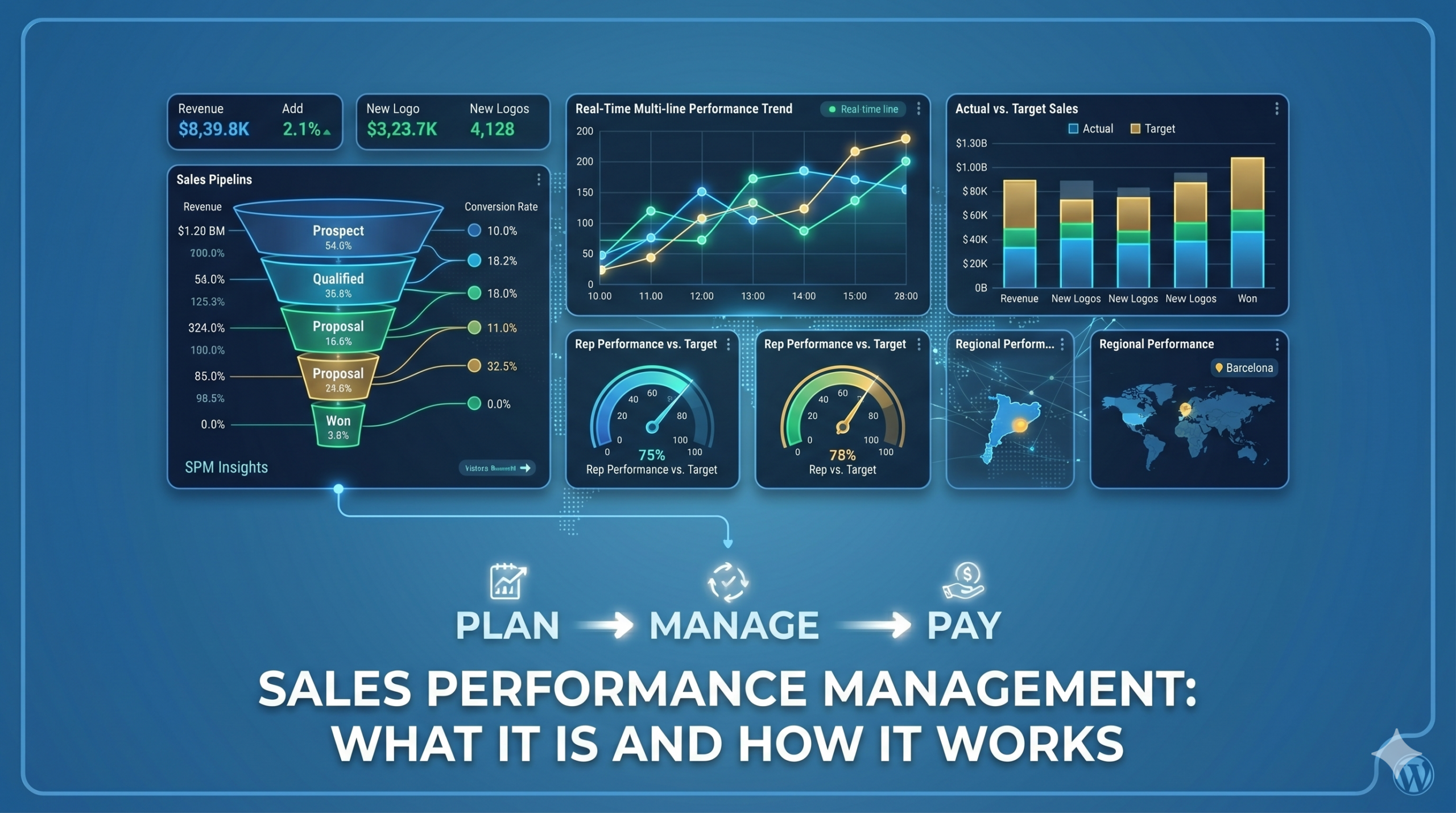
Salesforce SPM: What It Is and How It Works (Part 1 of 2)

What Is Salesforce Sales Performance Management (SPM)?

If you’ve searched for “Salesforce SPM” or “sales compensation software,” you’ve probably seen the term everywhere, but not always a clear explanation.

Salesforce Sales Performance Management (SPM) is a suite of tools that helps companies automate sales compensation, manage territories, and improve forecasting, all within the Salesforce ecosystem.

In this article, we’ll break down what Salesforce SPM is, what it includes, and why more companies are adopting it.


The Problem Salesforce SPM Solves

As sales teams grow, managing compensation and performance becomes increasingly complex.

Most organizations still rely on spreadsheets and manual processes. This typically leads to:

  • Hours spent calculating commissions every month
  • Frequent errors and disputes
  • Limited visibility for sales teams
  • Unbalanced territories and missed opportunities
  • Inaccurate revenue forecasts

These issues slow down operations and make it harder to scale.

Salesforce SPM addresses this by centralizing and automating these processes, improving accuracy, transparency, and efficiency.


What Is Salesforce SPM? (Simple Explanation)

At its core, Salesforce SPM helps you:

  • Automatically calculate commissions based on defined rules
  • Assign territories using data instead of manual decisions
  • Track performance and compensation in real time
  • Improve forecast accuracy using CRM data
  • Scale operations without increasing administrative workload

Instead of relying on spreadsheets, everything is managed in a single, connected system.


What Does Salesforce SPM Include?

Salesforce SPM is not a single product, but a combination of tools that work together:

1. Incentive Management

Automates commission calculations and provides full visibility into earnings and performance.

Why it matters:
Reduces manual work, eliminates errors, and builds trust with sales teams.


2. Territory Management

Distributes accounts and territories based on data, capacity, and opportunity.

Why it matters:
Ensures fair allocation and avoids conflicts between sales reps.


3. Sales Cloud

Acts as the central source of data, including opportunities, accounts, and pipeline.

Why it matters:
SPM relies on accurate CRM data to function properly.


4. Analytics (Forecasting & Insights)

Provides dashboards and predictive forecasting based on real-time data.

Why it matters:
Helps leaders make informed decisions and anticipate risks.


How Salesforce SPM Works

A typical implementation by an expert consultancy would follow these steps:

  1. Plan design
    Define compensation structures, quotas, and territory rules.
  2. System configuration
    Set up rules, dashboards, and integrations in Salesforce.
  3. Data preparation
    Clean and organize sales, account, and compensation data.
  4. Testing and validation
    Ensure calculations and assignments are accurate.
  5. Deployment and training
    Prepare teams to adopt the new system.
  6. Ongoing optimization
    Continuously refine plans and performance tracking.

A structured approach is critical to avoid rework and ensure adoption.


Salesforce SPM vs. Manual Processes

Here’s how Salesforce SPM compares to traditional spreadsheet-based management:

Area Manual Approach Salesforce SPM
Commission calculation Time-consuming and error-prone Automated and Accurate
Transparency Limited visibility Real-time insights
Territory planning Manual and subjective Data-driven and fair
Forecasting Based on estimates Based on real data
Scalability Difficult to mantain Easily scalable

Result: less manual work, fewer errors, and better decision-making.


Common Mistakes in SPM Implementation

Many companies struggle with SPM not because of the technology, but because of how it’s implemented.

The most common mistakes include:

  • Starting implementation before defining compensation plans
  • Using poor-quality or incomplete data
  • Underestimating change management and training
  • Automating inefficient or outdated processes
  • Not planning integrations with other systems

Avoiding these pitfalls is key to getting real value from SPM.


When Should You Consider Salesforce SPM?

Salesforce SPM is especially relevant if:

  • Your finance team spends too much time on commission calculations
  • Your compensation structure is complex
  • You have frequent disputes about commissions or territories
  • Your forecasts are unreliable
  • You’re scaling your sales team

If several of these apply, it may be time to explore a more automated approach.


What’s Next

In Part 2 of this series, we’ll cover:

  • Real use cases and examples
  • Implementation timelines and costs
  • How to evaluate if SPM is right for your business
  • What to look for in a consulting partner

Get Started with Salesforce SPM

Thinking about improving how you manage sales performance?

Start with a simple assessment of your current processes and identify where automation could have the biggest impact.

If you want a clearer picture of how Salesforce SPM would work in your organization, the next step is to evaluate your specific needs and challenges. Get started with Salesforce SPM!