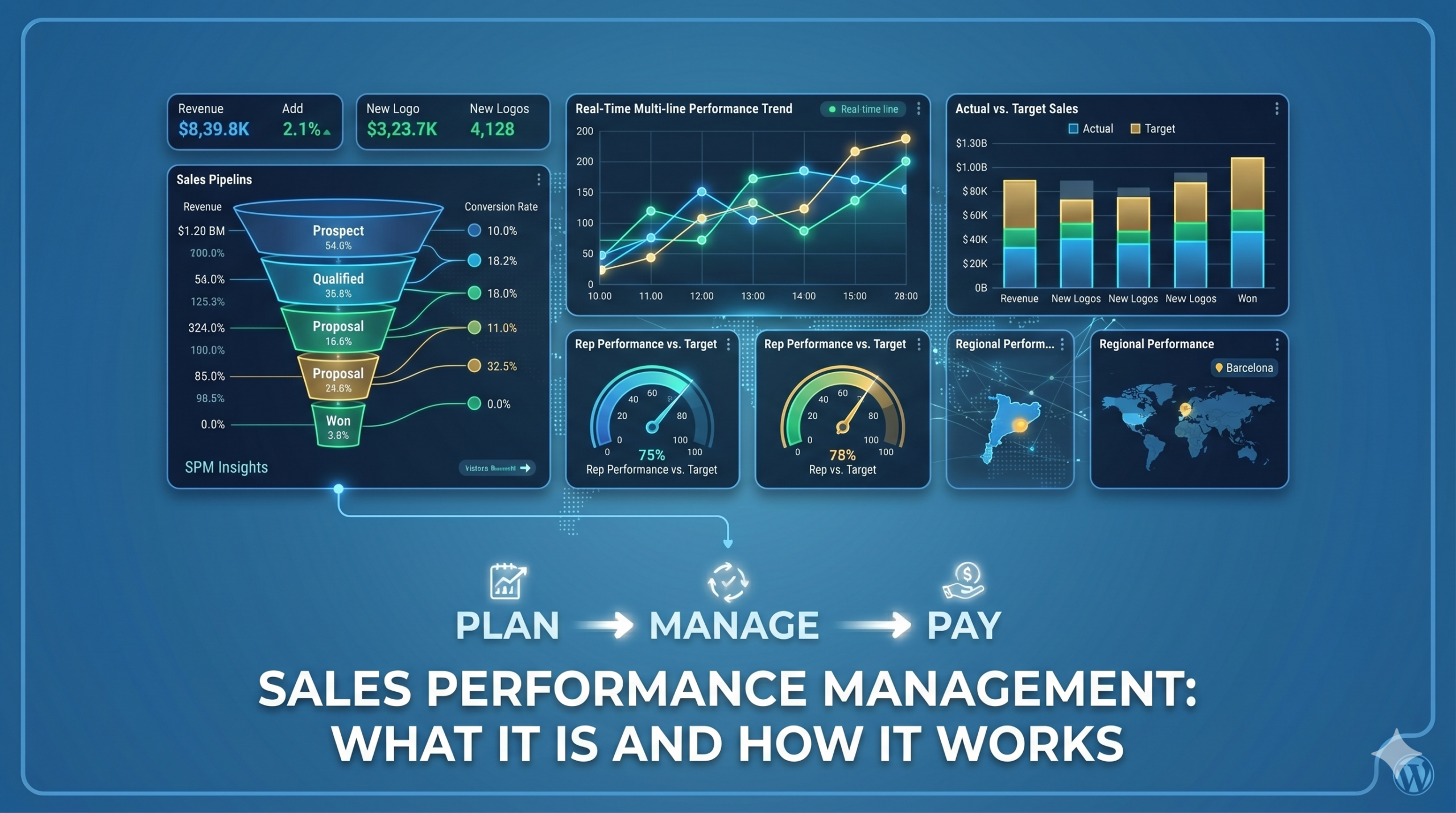
What Is Salesforce Sales Performance Management (SPM)?
If you’ve searched for “Salesforce SPM” or “sales compensation software,” you’ve probably seen the term everywhere, but not always a clear explanation.
Salesforce Sales Performance Management (SPM) is a suite of tools that helps companies automate sales compensation, manage territories, and improve forecasting, all within the Salesforce ecosystem.
In this article, we’ll break down what Salesforce SPM is, what it includes, and why more companies are adopting it.
- What Problem Salesforce SPM Solves?
- What is Salesforce SPM?
- What Salesforce SPM Includes?
- How Salesforce SPM Works?
- Salesforce SPM vs. Manual Processes
- Common Mistakes in SPM Implementation
- When Should You Consider Using Salesforce SPM in Your Organisation?
- More About Salesforce SPM
- Get Started With Salesforce SPM
The Problem Salesforce SPM Solves
As sales teams grow, managing compensation and performance becomes increasingly complex.
Most organizations still rely on spreadsheets and manual processes. This typically leads to:
- Hours spent calculating commissions every month
- Frequent errors and disputes
- Limited visibility for sales teams
- Unbalanced territories and missed opportunities
- Inaccurate revenue forecasts
These issues slow down operations and make it harder to scale.
Salesforce SPM addresses this by centralizing and automating these processes, improving accuracy, transparency, and efficiency.
What Is Salesforce SPM? (Simple Explanation)
At its core, Salesforce SPM helps you:
- Automatically calculate commissions based on defined rules
- Assign territories using data instead of manual decisions
- Track performance and compensation in real time
- Improve forecast accuracy using CRM data
- Scale operations without increasing administrative workload
Instead of relying on spreadsheets, everything is managed in a single, connected system.
What Does Salesforce SPM Include?
Salesforce SPM is not a single product, but a combination of tools that work together:
1. Incentive Management
Automates commission calculations and provides full visibility into earnings and performance.
Why it matters:
Reduces manual work, eliminates errors, and builds trust with sales teams.
2. Territory Management
Distributes accounts and territories based on data, capacity, and opportunity.
Why it matters:
Ensures fair allocation and avoids conflicts between sales reps.
3. Sales Cloud
Acts as the central source of data, including opportunities, accounts, and pipeline.
Why it matters:
SPM relies on accurate CRM data to function properly.
4. Analytics (Forecasting & Insights)
Provides dashboards and predictive forecasting based on real-time data.
Why it matters:
Helps leaders make informed decisions and anticipate risks.
How Salesforce SPM Works
A typical implementation by an expert consultancy would follow these steps:
- Plan design
Define compensation structures, quotas, and territory rules. - System configuration
Set up rules, dashboards, and integrations in Salesforce. - Data preparation
Clean and organize sales, account, and compensation data. - Testing and validation
Ensure calculations and assignments are accurate. - Deployment and training
Prepare teams to adopt the new system. - Ongoing optimization
Continuously refine plans and performance tracking.
A structured approach is critical to avoid rework and ensure adoption.
Salesforce SPM vs. Manual Processes
Here’s how Salesforce SPM compares to traditional spreadsheet-based management:
| Area | Manual Approach | Salesforce SPM |
| Commission calculation | Time-consuming and error-prone | Automated and Accurate |
| Transparency | Limited visibility | Real-time insights |
| Territory planning | Manual and subjective | Data-driven and fair |
| Forecasting | Based on estimates | Based on real data |
| Scalability | Difficult to mantain | Easily scalable |
Result: less manual work, fewer errors, and better decision-making.
Common Mistakes in SPM Implementation
Many companies struggle with SPM not because of the technology, but because of how it’s implemented.
The most common mistakes include:
- Starting implementation before defining compensation plans
- Using poor-quality or incomplete data
- Underestimating change management and training
- Automating inefficient or outdated processes
- Not planning integrations with other systems
Avoiding these pitfalls is key to getting real value from SPM.
When Should You Consider Salesforce SPM?
Salesforce SPM is especially relevant if:
- Your finance team spends too much time on commission calculations
- Your compensation structure is complex
- You have frequent disputes about commissions or territories
- Your forecasts are unreliable
- You’re scaling your sales team
If several of these apply, it may be time to explore a more automated approach.
What’s Next
In Part 2 of this series, we’ll cover:
- Real use cases and examples
- Implementation timelines and costs
- How to evaluate if SPM is right for your business
- What to look for in a consulting partner
Get Started with Salesforce SPM
Thinking about improving how you manage sales performance?
Start with a simple assessment of your current processes and identify where automation could have the biggest impact.
If you want a clearer picture of how Salesforce SPM would work in your organization, the next step is to evaluate your specific needs and challenges. Get started with Salesforce SPM!