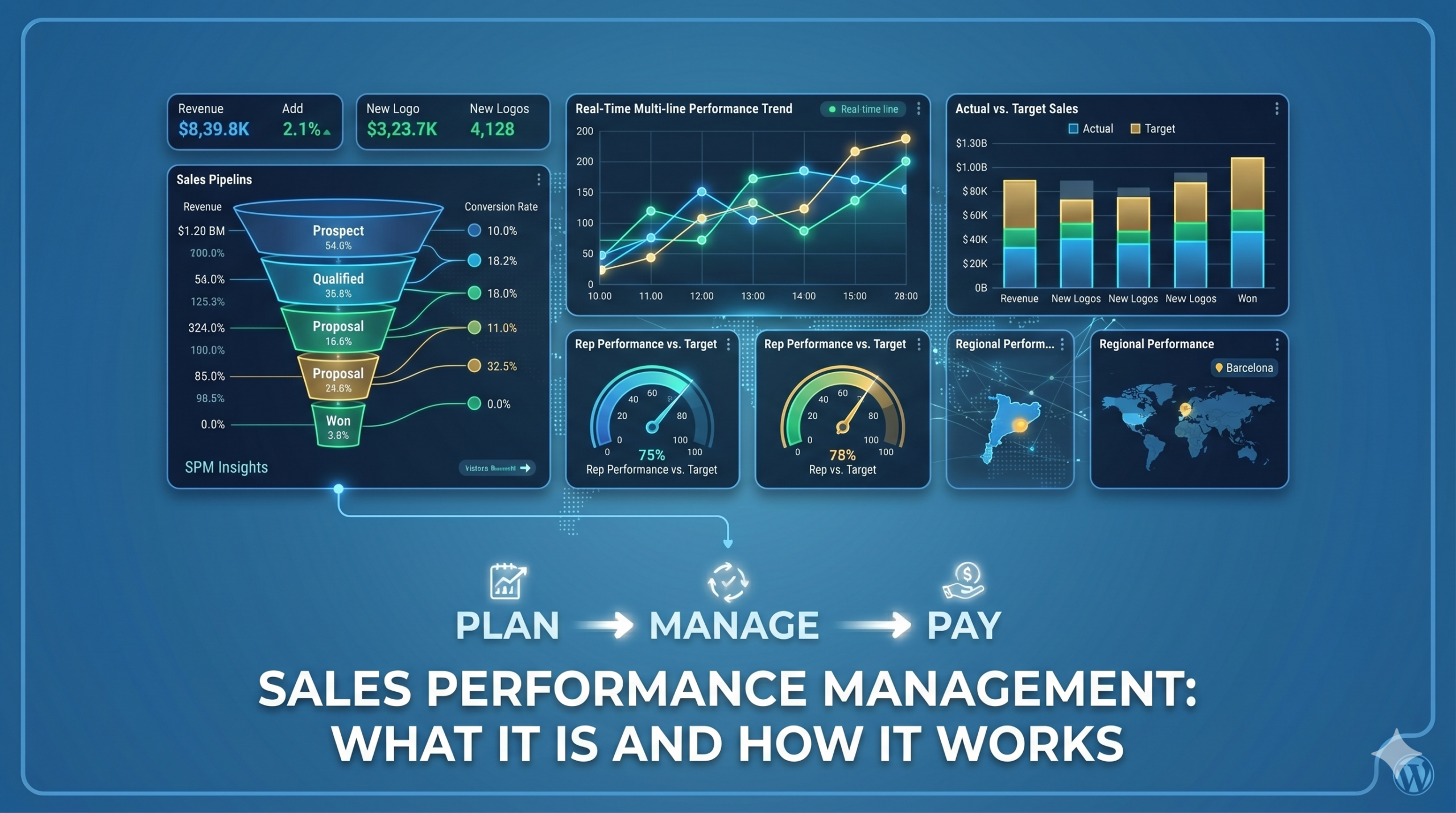
Salesforce SPM: What It Is and How It Works (Part 1 of 2)

What Is Salesforce Sales Performance Management (SPM)?

If you’ve searched for “Salesforce SPM” or “sales compensation software,” you’ve probably seen the term everywhere, but not always a clear explanation.

Salesforce Sales Performance Management (SPM) is a suite of tools that helps companies automate sales compensation, manage territories, and improve forecasting, all within the Salesforce ecosystem.

In this article, we’ll break down what Salesforce SPM is, what it includes, and why more companies are adopting it.

The Problem Salesforce SPM Solves

As sales teams grow, managing compensation and performance becomes increasingly complex.

Most organizations still rely on spreadsheets and manual processes. This typically leads to:

  • Hours spent calculating commissions every month
  • Frequent errors and disputes
  • Limited visibility for sales teams
  • Unbalanced territories and missed opportunities
  • Inaccurate revenue forecasts

These issues slow down operations and make it harder to scale.

Salesforce SPM addresses this by centralizing and automating these processes, improving accuracy, transparency, and efficiency.


What Is Salesforce SPM? (Simple Explanation)

At its core, Salesforce SPM helps you:

  • Automatically calculate commissions based on defined rules
  • Assign territories using data instead of manual decisions
  • Track performance and compensation in real time
  • Improve forecast accuracy using CRM data
  • Scale operations without increasing administrative workload

Instead of relying on spreadsheets, everything is managed in a single, connected system.


What Does Salesforce SPM Include?

Salesforce SPM is not a single product, but a combination of tools that work together:

1. Incentive Management

Automates commission calculations and provides full visibility into earnings and performance.

Why it matters:
Reduces manual work, eliminates errors, and builds trust with sales teams.


2. Territory Management

Distributes accounts and territories based on data, capacity, and opportunity.

Why it matters:
Ensures fair allocation and avoids conflicts between sales reps.


3. Sales Cloud

Acts as the central source of data, including opportunities, accounts, and pipeline.

Why it matters:
SPM relies on accurate CRM data to function properly.


4. Analytics (Forecasting & Insights)

Provides dashboards and predictive forecasting based on real-time data.

Why it matters:
Helps leaders make informed decisions and anticipate risks.


How Salesforce SPM Works

A typical implementation by an expert consultancy would follow these steps:

  1. Plan design
    Define compensation structures, quotas, and territory rules.
  2. System configuration
    Set up rules, dashboards, and integrations in Salesforce.
  3. Data preparation
    Clean and organize sales, account, and compensation data.
  4. Testing and validation
    Ensure calculations and assignments are accurate.
  5. Deployment and training
    Prepare teams to adopt the new system.
  6. Ongoing optimization
    Continuously refine plans and performance tracking.

A structured approach is critical to avoid rework and ensure adoption.


Salesforce SPM vs. Manual Processes

Here’s how Salesforce SPM compares to traditional spreadsheet-based management:

Area Manual Approach Salesforce SPM
Commission calculation Time-consuming and error-prone Automated and Accurate
Transparency Limited visibility Real-time insights
Territory planning Manual and subjective Data-driven and fair
Forecasting Based on estimates Based on real data
Scalability Difficult to mantain Easily scalable

Result: less manual work, fewer errors, and better decision-making.


Common Mistakes in SPM Implementation

Many companies struggle with SPM not because of the technology, but because of how it’s implemented.

The most common mistakes include:

  • Starting implementation before defining compensation plans
  • Using poor-quality or incomplete data
  • Underestimating change management and training
  • Automating inefficient or outdated processes
  • Not planning integrations with other systems

Avoiding these pitfalls is key to getting real value from SPM.


When Should You Consider Salesforce SPM?

Salesforce SPM is especially relevant if:

  • Your finance team spends too much time on commission calculations
  • Your compensation structure is complex
  • You have frequent disputes about commissions or territories
  • Your forecasts are unreliable
  • You’re scaling your sales team

If several of these apply, it may be time to explore a more automated approach.


What’s Next

In Part 2 of this series, we’ll cover:

  • Real use cases and examples
  • Implementation timelines and costs
  • How to evaluate if SPM is right for your business
  • What to look for in a consulting partner

Get Started with Salesforce SPM

Thinking about improving how you manage sales performance?

Start with a simple assessment of your current processes and identify where automation could have the biggest impact.

If you want a clearer picture of how Salesforce SPM would work in your organization, the next step is to evaluate your specific needs and challenges.

Salesforce Spiff: How to Automate Commissions and Motivate Your Sales Team

Eliminate manual errors, increase transparency, and scale without operational stress

How many hours does your sales and finance team spend reconciling commissions in spreadsheets? How many payment disputes have damaged relationships with your top performers?

If these questions hit home, you’re not alone. Most growing companies still manage sales incentives with Excel, emails, and manual processes. And when it’s time to scale, this operational chaos becomes a real bottleneck.

In episode 4 of NuvoTalks, Marc-Anthony Padula, Managing Director of  the Consulting entity, and Veronica Recanati, Senior Cloud Executive EMEA South at Salesforce, dove deep into how Salesforce Spiff transforms commission management. Here’s everything you need to know.

 What Is Salesforce Spiff?

Spiff is Salesforce’s native solution for managing sales incentive plans (SPM). It’s not a third-party add-on or a tool that requires expensive integrations. It’s a product built directly into the Salesforce cloud, designed to automate the entire commission cycle.

But here’s the catch: Spiff isn’t for every company. It’s built for sales teams that need:

  • Complex commission structures (multiple products, territories, conditional bonuses)
  • Scalability (growth without operational pain)
  • Real-time transparency (reps know exactly what they’ll earn)
  • Absolute precision (zero calculation errors)


The 4 Pillars of Spiff: Why It Transforms Your Business

1. Efficiency and Precision: Say Goodbye to Excel

Manual commission management has a hidden cost that most companies overlook. It’s not just the hours your teams spend on calculations and reconciliations. It’s also the risk of errors.

A 2% calculation error in commissions for 50 reps doesn’t sound significant. Until you factor in months of audits, payment disputes, and lost trust. Spiff eliminates this risk automatically:

  • Automatically calculates commissions based on rules you define
  • Applies bonuses, deductions, and adjustments without manual intervention
  • Generates complete audit reports (your CFO will love this)
  • Flags anomalies before they become problems

2. Sales Motivation: Visibility Drives Performance

This is where Spiff creates real impact on your business numbers.

When your sales team can see in real time how much money they’ll earn on each deal, behavior changes. It’s not magic. It’s applied psychology.

Spiff gives each rep a personal dashboard where they can:

  • Track their progress against commission targets
  • Calculate the financial impact of each deal
  • Understand exactly how their incentive plan is structured


Transparency doesn’t just boost motivation. It also reduces friction between sales and finance.

3. Scalability: Grow Without Operational Chaos

When a company grows from 5 reps to 50, Excel breaks. You need:

  • Multiple territories and assignment geometries
  • Different plans for different deal types (SaaS, services, implementations)
  • Monthly adjustments without losing control
  • Complete auditability for regulatory compliance


Spiff is built specifically for this scenario. You can add reps, products, and business rules without breaking anything. The architecture supports complexity without operational friction.

4. Native Salesforce Integration

Unlike external tools that require complex syncs, Spiff lives inside Salesforce. This means:

  • Data flows automatically from Opportunities to commissions
  • No delays or discrepancies between your CRM and commission system
  • Salesforce’s security and permissions protect commission data
  • Everything lives in one place (fewer tools, less complexity)


Who Should Implement Spiff?

Spiff isn’t for everyone. It’s especially relevant if your company:

  • Has 20+ sales reps
  • Manages multiple deal types with different commission structures
  • Is growing quickly and needs to scale operations without expanding the finance team
  • Already uses Salesforce and wants native integration (no plugins)
  • Suffers from frequent payment disputes or lack of transparency

If your sales team fits in a single Excel sheet with one commission structure, Spiff is overkill. But if you’ve seen Excel break under pressure, Spiff is the answer.

The 3 Mistakes Companies Make (And How Spiff Fixes Them)

Mistake 1: Managing Commissions Manually While Scaling

Most growing companies wait until the pain is unbearable before switching. Then they rush the implementation, cut corners, and the project fails.

Spiff works best when you implement it as part of your scaling strategy, not as an emergency patch.

Mistake 2: Not Communicating Commission Rules Clearly

If your team doesn’t understand how commissions are calculated, they can’t optimize their selling behavior. Spiff solves this by giving them transparency, but you need to ensure the rules are crystal clear from day one.

Mistake 3: Implementing Spiff Without Reviewing Your Incentive Plan

Spiff automates what you already do. If your commission plan is poorly designed, Spiff just automates the chaos.

Real value comes from rethinking your incentives while implementing the tool. Are your commissions aligned with business objectives? Do they motivate the behavior you actually want? Answer these questions before Spiff, not after.

From Salesforce’s Perspective

According to Veronica Recanati in the episode, Spiff addresses a specific problem: most companies have rich CRM data but don’t leverage it to drive sales behavior.

Spiff closes that gap. It takes deal data from Salesforce and translates it directly into commissions. This means your incentive plan is connected to your real pipeline in real time.

When Should You Implement Spiff?

Short answer: as soon as you have a scaling problem, it should be on your roadmap.

Long answer: it depends on your situation. But if you recognize any of these symptoms, it’s probably time to talk to a specialist:

  • Excel has become your primary commission management tool
  • Sales and finance don’t trust the commission numbers
  • Changes to your incentive plan require days of manual work
  • Your CFO is pushing for automation because manual work doesn’t scale
  • You’re planning to enter new markets or add new product lines


The Next Step: Nuvolar + Spiff

If Spiff is on your radar but you’re not sure where to start, you’re not alone. Correct implementation requires understanding:

  • Your current commission architecture (how it works today, what’s broken)
  • The business rules to automate (what needs to live in Spiff)
  • Organizational change (how to train your team on the new tool)
  • Salesforce integration (how data flows, how to ensure accuracy)


At Nuvolar, we’ve guided teams through this transformation. We know where the pitfalls are, what questions to ask, and how to design a commission plan that works with Spiff—not against it.

If you want to see Spiff in action or discuss how it could work in your specific context, we’re running a live webinar where we’ll demonstrate Spiff functioning in a real sales scenario.

Register here: https://meet.zoho.eu/uzxi-pdy-fhw

The Bottom Line

Salesforce Spiff isn’t just another tool. It’s the bridge between your business objectives and your sales team’s behavior. It automates the tedious work, brings transparency to what was opaque, and scales what worked on a smaller level.

The question isn’t whether you should implement Spiff. It’s: how long can you afford to wait?


Published by Nuvolar Consulting

We create intelligent digital solutions built on data, artificial intelligence, and human expertise. If your company faces operational scaling challenges or needs Salesforce expertise, let’s start a conversation.