Custom Software vs SaaS: Which Fits Growth?

Disconnected ‌workflows ‌rarely ‌flag themselves as tech trouble. Instead they surface when sales teams export spreadsheets, operations skirt around a CRM, compliance teams chase audit evidence, leaders decide with incomplete data. Custom software versus SaaS in that setting stops being a simple procurement call. It becomes a question of how much operating model your group wants to own configure and differentiate.

SaaS platforms yield fast measurable progress. Custom software yields capabilities a standard platform cannot reasonably provide. The right choice hinges less on which option is better and more on where your organization needs speed control strategic distinction.

Start With the Business Constraint, Not the Technology

The most expensive mistake is selecting technology before defining the business problem precisely. A SaaS product may look compelling in a demo, while a custom application may appear attractive because it promises a perfect fit. Neither delivers value without a clear view of the workflows, users, data, integrations, and governance requirements involved.

For a relatively standard process, such as managing routine service tickets, marketing automation, expense approvals, or internal collaboration, SaaS often provides a practical starting point. Mature vendors have already invested in common capabilities, security controls, product updates, and user experience patterns. The organization can focus on adoption and process discipline rather than building baseline functionality from scratch.

The equation changes when the workflow itself creates competitive advantage or carries significant operational risk. An airline coordinating exception-based ground operations, a healthcare organization managing sensitive patient pathways, or a manufacturer connecting field service activity to complex asset data may need rules, interfaces, and integrations that exceed a platform’s intended design. For these organizations, forcing a distinctive process into generic software can create years of manual workarounds.

A useful question for executive teams is this: if a competitor adopted the same SaaS platform tomorrow, would it replicate a meaningful part of how we create value? If the answer is yes, the capability may warrant a more tailored approach.

##People ‌often ‌call ‌it build versus buy.

That ‌label ‌sits ‌too neat though. Most organizations have no cause to start a full system from scratch, nor should they grab an app and accept every limit that comes with it. What matters instead is sorting out how to fit the pieces into something that actually supports the business, done with clear intent.

Core Operational Trade-offs: SaaS vs. Custom

When evaluating your technology architecture, the differences between these two paths map across several distinct operational categories:

  • Time to Initial Deployment: Usually runs faster with SaaS, especially for standard processes, while custom software stretches through longer discovery, design, development and testing cycles.

  • Functional Fit: Stays strong for common use cases under SaaS yet remains constrained by product boundaries; custom software gets designed around specific workflows, roles and business rules instead.

  • Upfront Investment: Stays lower with SaaS through its predictable subscription model, though custom work demands higher initial outlays shaped by scope and complexity.

  • Integration Flexibility: Hinges on APIs, connectors and vendor limits in the SaaS case, whereas custom builds can be shaped around the existing technology landscape.

  • Ownership and Control: Leave the vendor in charge of roadmap, release timing and core architecture for SaaS, but the organization steers priorities, roadmap and product direction when building custom.

  • Maintenance Responsibility: Falls to the vendor for the product itself, with internal teams handling only configuration and adoption, yet custom software calls for ongoing engineering, support, security and enhancement planning.

Flexibility and Delivery Methods

This comparison offers no final say. SaaS allows high configurability, especially on platforms like Salesforce or Zoho; custom software on the other hand gets rolled out bit by bit starting from a narrow feature instead of some huge multiyear effort.

The Bottom Line: Where the constraints sit marks the real difference. With SaaS the organization bends to fit the product’s architecture. With custom software architecture bends to fit the organization’s requirements.

Discussing ‌costs? ‌Don’t ‌skip operations.

People often label SaaS as the more cost-effective choice, at least initially. Yet, staring down the starting price and understanding the total cost of ownership can be two very different tasks.Subscription fees? They rise quickly. User numbers might swell, storage could grow exponentially, and before you know it, premium modules, integration tools, and enhanced support start to pile on. But watch out for those less obvious expenses, too: duplicate data entry across systems, consultant fees to untangle complex setups, bothersome custom code requiring constant upkeep, revenue losses where the platform just doesn’t quite cut it.

Going for custom software? It demands a thoughtful outlay of cash upfront. You can’t skimp on discovering needs, crafting the user experience, engineering, quality assurance, security, or change management—they all need backing. It’s a commitment that doesn’t vanish after launch. A tailor-made solution necessitates vigilance, documentation, security updates, tech support, and a well-planned path for future upgrades. Without lifecycle planning, it’s not true ownership; it’s just risk postponed.A sensible financial evaluation spans three to five years and dives deeper than just counting license fees. Think about boosts in productivity, lowered error rates, integration expenses, risks of not complying, the effort it takes to implement, how users warm up to it, and the cost of lost opportunities. When dealing with enterprise processes that handle loads of transactions or impact customer retention even small tweaks can make a noticeable shift in your business case.

Integration Is Often the Deciding Factor

Many ‌mid-market ‌and ‌enterprise businesses tend not to settle on just one application standing alone. They weave together CRM, ERP, finance systems, data platforms, customer portals, mobile apps, identity frameworks, AI services, and old applications. These dated systems won’t fade away instantly.

Software as a Service (SaaS) thrives when it aligns well with the architecture truly required. Strong APIs, well-established connectors, articulate data models, dependable event capabilities, these components can transform a platform into a precious hub. Salesforce might lay the groundwork for managing customer and revenue operations, while other linked services tackle specific niches.

Yet, integration extends beyond just the technical sphere. It dictates where data gets anchored, which teams find it reliable, how exceptions are managed, and the auditability of processes. A badly conceived integration framework can leave companies with shiny front-end tools but masks a fragmented operational structure underneath.

Custom software is particularly valuable when it can act as an orchestration layer across systems. Rather than replacing every platform, it can provide a unified experience for users while coordinating data and workflows behind the scenes. This approach is often effective for organizations with complex cases, regulated processes, or differentiated service models.

Compliance, Security, and Governance Change the Calculation

In ‌fields ‌like ‌healthcare, life sciences, insurance, financial services, and aviation, picking software goes beyond the listed features alone. Organizations must handle data residency details, control access rights, keep audit trails intact, meet validation requirements, follow retention rules, and prepare for incidents.

Reputable SaaS providers usually maintain strong security programs and certifications that would cost plenty to build alone, which draws interest provided those measures match needs and allow adjustments. Their security features deliver results only when roles, permissions, integrations, and data practices receive proper oversight.

Custom software instead grants tighter command over workflows and data access, yet it shifts added duties onto the organization and its delivery partner alike. Security and privacy must shape such builds from the first stages onward. It carries no automatic edge in safety, though disciplined design, testing, and upkeep let it match a given risk profile better as rules and threats change.

Consider a Hybrid Model Before Choosing Sides

For many transformation programs, the most sensible answer is not custom software or SaaS. It is SaaS for the capabilities that should be standardized, combined with custom components where the business needs differentiation.

A consumer goods company might use a CRM platform for account management and campaign execution, while developing a custom trade-promotion workflow that reflects its commercial model. A transportation company might retain an established ERP while building a tailored operations portal that gives dispatchers a clearer, faster way to manage exceptions. In both cases, the SaaS platform remains valuable, but it is not asked to solve every problem.

This model reduces unnecessary development while avoiding the operational compromises that occur when teams stretch a standard product beyond its practical limits. It also supports phased investment. Start with the workflow where friction, risk, or opportunity is most visible, establish an architecture that can scale, and expand based on measured outcomes.

Mapping ‌your ‌current ‌process comes first when decisions need real weight.

Spot the spots where work slows down, where data loses its footing and where teams lean on workarounds no one officially admits to. Separate what the business truly requires from habits left behind by earlier tools.Run every capability past four filters: strategic edge, how much the process shifts, how tangled the connections are, and how much regulation it touches. High differentiation paired with high variability usually points toward a solution built for that need.

Capabilities that stay steady and uniform lean toward SaaS instead. When integration grows messy a hybrid setup can help, especially if replacing core systems would add more risk than it removes.Readiness inside the organization counts just as heavily. Custom work calls for someone to own the product, set priorities, weigh trade-offs, represent users and keep the plan from drifting. SaaS still needs oversight, particularly once departments start adjusting the platform on their own.

Intentional technology rests on clear decision rights; budget sign-off by itself never suffices.The partner you pick shapes the outcome because the effort stretches across strategy, design, data, engineering and change work.

Nuvolar approaches these choices as questions of ecosystem design, linking platform features to the workflows and results that count.Pick one process where the price of settling shows up plainly and in numbers. Put that process to the test: can an existing platform deliver the needed experience without heavy customization, or would a tailored capability give a smoother route to growth. The answer anchors any larger technology plan better than broad build-versus-buy debates ever manage.


Beyond the Silos: Why Pharma CRM and System Integration Drive Growth

The Cost of Disconnected Data in Pharma Commercial Stacks

Disconnected ‌data ‌costs ‌pharma operations plenty when big players such as Bayer Novartis Boehringer Ingelheim and AstraZeneca keep commercial tools apart from one another. Sales groups move without sight of medical efforts compliance stays isolated finance grabs figures supply chain overlooks and all this separation wears down efficiency leaving approvals delayed operations untraceable duplicate records and reports lacking trust. Pharma CRM systems SAP setups and custom software joined by hand do not qualify as IT work to delegate and set aside because in life sciences today they underpin growth that meets compliance needs.

Why pharmaceutical companies struggle with CRM and SAP or other system integration

Before reading the full article Check out our testimonial done by Miguel Angel Fernandez, Senior manager at Roche Diagnostics:

Nuvolar stands out as a high-caliber technology partner. Their team’s deep expertise and capability are evident in the quality of their work and the advice they provide. They are a reliable extension of our internal resources, helping us navigate complex challenges and maintain our high standards of delivery.

Pharma ‌settings ‌rarely ‌stay simple. Different business units bring their own processes along with local market rules and data standards that clash often. Regulations pile on extra layers, especially around customer details, consent records and audit trails that keep promotions in line. Projects meant to link systems together tend to stall when leaders overlook how much process planning matters upfront. At Nuvolar we have handled CRM and similar tools for pharma clients across many cases. A CRM can pull customer exchanges into one spot yet it stays limited unless stock levels, prices, contract details and master records stop sitting locked inside SAP or scattered regional setups. The reverse holds too, SAP or ERP platforms hold operational and financial details but sales teams miss context from the CRM side so decisions slip at key moments. Point to point links often fall short for that reason; they fix one short term snag while leaving fragile links, uneven rules and governance gaps that widen after each new market or product addition. Check how Nuvolar lifted Karo Pharma commercial visits by 93 percent in this case study


What ‌does ‌a ‌good system integration look like in Pharma.

Effective integration starts with business outcomes, not interfaces; leadership teams usually want a few things at once, a better customer view, cleaner reporting, stronger compliance, less manual work. Achieving that requires deliberate architecture. Good architecture is essential. In practice this means defining which system owns each critical data object; all need clear rules, without them integration becomes a technical exercise. This is what our architects are expert in.

For pharmaceutical companies CRM and other systems should also reflect role-based needs: salespeople need timely account and activity visibility. Medical affairs may require controlled access to scientific interactions. Finance teams need billing realities to align with commercial actions. Compliance stakeholders need traceability; one integration layer cannot treat every workflow the same.

The role of custom software development

Off-the-shelf ‌connectors ‌might ‌speed things up but they rarely match the entire pharma way of working and that’s exactly where custom software steps in to fill the space. Middleware alongside workflow apps and bespoke services can bridge CRM to SAP or any other specialized system tucked away in the corner without forcing the business into some generic mold.

This matters most for organizations that run unique approval chains along with market-specific reporting rules and legacy tools still humming along to support critical ops. Custom work also cuts user friction by surfacing the right data inside systems people already live in; nobody wants to hop between five platforms hunting for one number.

Governance though remains the trade-off build with maintainability in mind document properly and think about scale down the road then custom solutions create real value. Skip those steps and you’re just piling on technical debt. A delivery partner worth anything will push back on customization for its own sake save it for spots where the operational or compliance edge is obvious.

A new way of managing pharma CRM: software, SAP, system integration

The ‌best ‌programs ‌kick off with something practical an evaluation. Ask your people directly which processes cause headaches where data gets punched in twice by hand which reports draw skepticism and which compliance risks stem from workflows left unconnected these questions reveal whether the real need sits in platform replacement organizational improvements or software built to mesh with existing systems.

Architectural decisions demand weighing how fast something can shift against how long it stays under control some organizations require a phased roadmap first stabilizing CRM and SAP data flows then layering in analytics automation AI. Others face acquisition pressures or geographic fragmentation so severe the current landscape simply fails them redesign becomes urgent at Nuvolar we guide you through these steps no stress.

A pattern we notice leadership treats integration as secondary it is not. Technology built with intention supports compliant execution sharper visibility scalable growth across a tangled pharmaceutical environment that demands more than implementation skill it demands a partner who grasps enterprise platforms human workflows the operational mess hiding behind every data model when pharmaceutical companies view CRM SAP surrounding integrations as pieces of one intelligent ecosystem they stop wrestling isolated tools they start building the clarity stronger commercial performance requires.

We offer free consultations! Contact us today via this link!

8 Digital Transformation Strategy Examples

The ‌conversation ‌around ‌real transformation tends to start after a CRM rollout flops, spreadsheets patched together and three teams each defining the same customer their own way, we have all seen this sort of thing. Leaders searching for digital transformation strategies want patterns that lower risk, set priorities straight and tie technology choices to business results one can actually measure. Nuvolar works on exactly that, backing leaders through those decisions.

Strong strategies grow from business friction, slow service delivery or poor visibility, inconsistent data, compliance pressure, systems that fail to support growth, rather than trendy tools, even if some think otherwise. That is why the most useful examples show how companies align their operating model with platforms, people and governance, software selection aside.

What strong digital transformation strategy examples have in common

Transformation ‌strategies ‌that ‌work across fields often start from the same place. A real operational issue sits at the core, not some loose idea about updating everything. You figure out exactly what you need and want right away. Then comes pinning down what improvement actually means on the ground: things like faster cycles, better data, more people using the system, less manual work, forecasts you can trust, or rules followed properly. Trade offs get spotted before they bite.

You push for speed yet skip the checks and end up fixing things twice over. Standardizing helps things grow but push too hard and key processes snap. AI boosts how much gets done, sure, provided the data underneath holds up. Strong plans lay those choices out in plain sight.

 1. CRM consolidation to create a single commercial operating model

Commercial ‌fragmentation ‌sets ‌most digital transformation efforts in motion, and the same pattern shows up in company after company. Sales sticks with its own system, service clings to another, operations patches gaps using spreadsheets that nobody quite believes. Records duplicate without end. Processes clash from one department to the next.

What comes next surprises nobody, users stop trusting the data, reports give only half the picture, customers feel the mess even when they cannot put a name to it.Moving everyone into a single CRM fixes little by itself.

A real strategy reaches further, it reshapes how leads move forward, decides who owns accounts, reworks service workflows, and chooses the numbers leaders actually track. Teams must settle the basics first. When does an opportunity count as ready? How does one log a call, an email, a complaint? What figures reach the executive dashboard, and why those figures?

The value is not simply better visibility. It is a commercial model that scales. For enterprise and mid-market organizations, especially those [using Salesforce or Zoho](https://nuvolar.com/picking-the-right-salesforce-consulting-partner-for-your-business-a95ba2585cc4/), this approach can improve forecast accuracy, reduce handoff failures, and give revenue leaders a more credible operating picture.

 2. Workflow automation in compliance-heavy environments

In ‌sectors ‌heavy ‌on rules, from healthcare through insurance and on to aviation or life sciences, change often kicks off right where snags meet the weight of oversight and compliance. Approvals stack up by hand; papers get hunted down from one team to the next; records of checks sit apart, unlinked. Things slow down, and risks grow.

A better route opens up when automation of flows gets built with oversight right from the start. Instead of just layering new systems over broken steps, groups map out choices first, lock in what must be controlled, then set auto skips where rules allow. Routing for signs off, handling of cases, checks on papers, all get formed so that pace and responsibility stay together, neither lost to the other.

Success or stall often hangs on this point. Push only for quicker steps and watch the compliance side push back hard. Load too many checks in and people slip around them, finding side paths past the setup you planned with care. The steadier choice makes oversight feel natural inside how folks work day to day; not added later as an extra gate, not a separate stop. It becomes the way the tasks move along.

3. Data unification for operational clarity

Many ‌organizations ‌wind ‌up with dashboards everywhere yet few choices actually taken from them. Data sits split across ERP platforms, CRMs, support tools, finance systems and departmental trackers; leaders argue over whose figures hold up instead of moving forward with them. Clean consistent data remains the only workable path when AI enters the picture. Building one shared data setup around core decisions counts among stronger moves in shifting how firms handle information.

Aligning customer records, product details, claims, patient files, supplier info or service entries across tools lets teams draw from a single reliable picture. Tying that effort to a concrete result makes the difference. Improved service plans, clearer margin views, demand forecasts or executive reports push adoption further than any broad push toward data use alone. When changes link straight to choices people make daily, uptake rises and the case for spending holds up easier.

4. Legacy modernization through phased architecture change

Because ‌big ‌replacement ‌efforts stumble when they overhaul all at once organizations holding onto old systems embedded deep find more sense in gradual updates. Not to keep things tangled on purpose though but to cut down risks in daily work and open space for real gains instead.

Take how teams might pull apart the parts customers see or the workflows that eat up time from the old heart of things first like those custom builds at https://nuvolar.com/service/custom-software-development/ .

Then they get to shape new front ends; smooth out steps automatically pull info together without touching the whole back side right away. Choices on structure grow more thoughtful as days pass less driven by panic. Patience and steady hands become necessary here.

On paper the step by step way drags a bit yet it brings quicker wins in practice by dodging the chaos of swapping everything out. Many big company setups see this as the route that holds up better.

5. Customer experience transformation across channels

Customers ‌often ‌expect ‌more consistency than companies can deliver across web email phone field teams and self service channels. Yet those paths usually sit with separate departments each running its own tools and metrics.

A solid transformation approach traces the full customer path spots the weak spots then pulls systems and teams together around the key moments that count. That alignment might cover things like case routing customer identity service history knowledge access or personalized communication all the bits that tie it together.

The case for change goes past satisfaction numbers alone. Stronger experience tends to cut service costs hold on to more customers and trim the churn that comes from needless friction. Still it only lands if the work cuts across those silos. Improvements to one channel by itself often leave a shiny front end sitting over the same old operational snags underneath.

6. AI adoption grounded in process value, not experimentation alone

AI now appears in nearly every boardroom conversation, but many initiatives still begin with the technology rather than the business problem. A more effective strategy example starts by identifying where AI can improve decision quality, reduce repetitive work, or surface insights that teams cannot access quickly enough on their own.

That might include support triage, sales prioritization, document classification, forecasting assistance, or anomaly detection. The common thread is that the use case sits inside a defined workflow. It has owners, input data, thresholds for confidence, and a clear path for human review.

This is where strategic discipline matters. Not every process should be automated, and not every model deserves production deployment. Organizations that move well in this area tend to combine AI with data governance, UX thinking, and operational change management. The goal is technology with intention, not AI as theater.

7. Field operations digitization for speed and visibility

Away ‌from ‌headquarters ‌the real shifts in transportation manufacturing aviation and service businesses take shape. Field crews keep turning to paper forms disconnected tools or updates that lag behind and this erodes planning while confusing customers. Digitizing what happens in the field and connecting it right to central systems makes for a workable plan.

Scheduling inspections incident handling work orders asset records all get noted as they occur and flow into reports for operations.Gains go beyond just output. Field operations service and leaders coordinate better yet usability decides if it works.

Mobile apps that slow things down or add layers people quit them quick. Design that puts humans first isn’t optional here it forms one of the main requirements if change is to stick.

8. Post-merger platform integration to protect growth

Companies ‌pick ‌up ‌duplicate systems and scattered customer records after mergers or regional growth and local process quirks join in making scale tougher rather than simpler. One workable path through digital change involves post merger work shaped around a target operating model.

This approach skips any rush toward full sameness and instead marks out the pieces that need standardizing early customer data finance rules service steps reporting lines while leaving room for flexibility in other spots for now. It lays out an order for pulling systems together so the effort avoids becoming a contest over which original setup survives.

Growth can mask weak spots in structure for a time yet those issues surface eventually when split platforms cut visibility raise support costs and spark questions around oversight. A steady plan for integration keeps the gains from expansion intact instead of letting added complexity swallow them.

How to choose the right strategy example for your organization

Choosing ‌strategy ‌for ‌your organization comes down to pressure points inside the business. Where revenue teams miss visibility start perhaps with CRM alignment and data work first. Compliance drags execution along; redesign the workflows and fold governance in early as the wiser entry.

Leadership wants AI yet data stays messy so the effort may need to start deeper down the stack. Hence why IT alone should not set the full scope for any transformation. Strongest efforts emerge when operations commercial leads compliance and platform owners shape things together. There the plan turns executable.

Often at Nuvolar you see the split between a project that just drops in tools and a program that builds a scalable smarter operating setup. Pick a direction fixing an actual constraint one that holds up after launch. Rarely does the flashiest path win it is the one that clears the view quicker and lifts capability with each move forward.

Source: Linda A. Hill: Digital Transformation: A New Roadmap for Success .
Harvard business school
https://www.library.hbs.edu/working-knowledge/leading-in-the-digital-era-a-new-roadmap-for-success

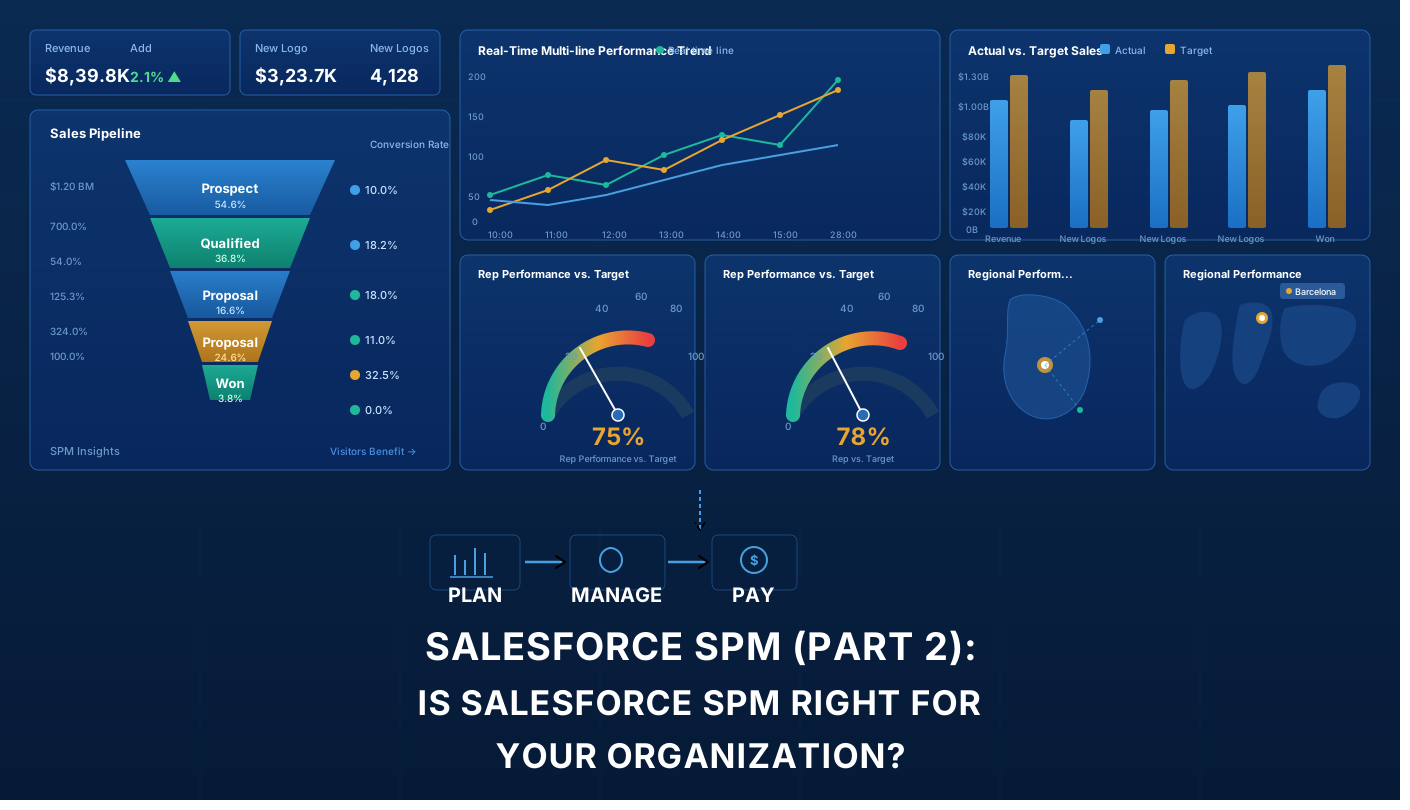
Salesforce SPM: Use Cases, Implementation Timeline, and ROI (Part 2 of 2)

Is Salesforce SPM Right for Your Organization?

In Part 1 of this Salesforce SPM series, we explored what Salesforce Sales Performance Management is, how the different products work, and why expert Salesforce consulting matters.

But you still might be wondering: Is Salesforce Sales Performance Management right for my organization? When does the ROI actually justify the investment? How long does Salesforce SPM implementation take? And what should we expect to invest?

This Part 2 answers those questions. We’ll explore real-world use cases, help you determine if Salesforce SPM fits your company size and industry, break down implementation timelines and budgets, and discuss the actual ROI you can expect.


Who Needs Salesforce SPM? Company Size Analysis

Not every organization needs Salesforce SPM. Here’s where it makes sense:

Startups (1–50 employees) — Not yet. Your sales process isn’t complex enough. Basic Sales Cloud with simple commission tracking is sufficient. Revisit when you hit $5M+ ARR with 20+ reps on multiple compensation structures.

Growth-stage (50–250 employees) — This is the inflection point. SPM starts making financial sense when commission calculations consume 30+ hours/month, forecasts are off by 15%+, and spreadsheets can’t keep up. Expect 12–18 months to payback on a $200–450K Year 1 investment.

Mid-market (250–1,000 employees) — Highly recommended. At this scale, the cost of not implementing SPM — errors, attrition, forecasting gaps — typically exceeds the investment. Payback: 6–12 months. Investment: $400K–$1M Year 1.

Enterprise (1,000+ employees) — Essential. Compliance, multi-currency support, board-level forecasting, and ERP integration make centralized SPM non-negotiable. Payback: 4–8 months. Investment: $1.1M–$3M+ Year 1.


5 Problems Salesforce SPM Solves

Use Case 1: “Our Commission Calculations Are Killing Finance”

The Situation

Your finance team spends 40+ hours per month calculating commissions using spreadsheets. Multiple people are involved. Errors happen. Salespeople dispute payouts. Finance is exhausted.

The Business Impact

  • Month-end close is delayed by days or weeks
  • Commission disputes create HR escalations
  • Finance team burnout is high
  • Errors undermine trust in the compensation system
  • Errors cost thousands in overpayments or missed payouts

How Salesforce SPM Solves It

Salesforce Incentive Management automates commission calculations entirely. Finance inputs rules once; the system applies them consistently to every salesperson, every month, every year.

The Transformation

  • Commission processing drops from 40 hours to 4 hours per month
  • Calculation errors drop by 95%+
  • Finance team has time for strategic analysis instead of manual calculations
  • Salespeople trust the system because calculations are consistent and auditable
  • Month-end close accelerates significantly

Typical Results: 30-50 hours per month freed up in finance, 95%+ reduction in commission disputes, 100% calculation accuracy

Company Size This Affects Most: 50+ salespeople, multiple commission structures

Payback Period: 6-12 months


Use Case 2: “We Can’t Forecast Revenue Accurately”

The Situation

Every quarter, your forecast is wrong by 15-25%. You can’t predict cash flow. Investors get frustrated. Leadership makes decisions based on guesses, not data.

The Business Impact

  • Cash flow surprises create financial challenges
  • Board and investor confidence erodes
  • Hiring and resource planning are inaccurate
  • Strategic decisions lack data foundation
  • For public companies, this affects stock price and credibility

How Salesforce SPM Solves It

Salesforce Analytics Cloud integrates with your Sales Cloud data to provide real-time revenue forecasting with predictive models that achieve 90%+ accuracy. The system leverages:

  • Pipeline data and deal probability
  • Historical performance patterns
  • Real-time sales activity and pipeline velocity
  • Seasonal trends and cycles
  • Territory and rep-specific performance

The Transformation

  • Forecast accuracy improves from 75-80% to 90%+
  • Cash flow becomes predictable
  • Leadership makes confident strategic decisions
  • Investors have confidence in guidance
  • Resource planning is accurate

Typical Results: 20-25% improvement in forecast accuracy, better cash flow management, improved investor/board confidence

Company Size This Affects Most: Any size, but especially enterprises and venture-backed companies where forecasting directly impacts investor relations

ROI: For a $100M revenue company, a 15% improvement in forecast accuracy can represent $15M in better-managed cash flow.


Use Case 3: “Salespeople Don’t Understand Their Compensation”

The Situation

Your sales team doesn’t understand how their compensation is calculated. They feel quotas are unfair. Turnover increases. You lose top talent to competitors.

The Business Impact

  • Sales team morale is low
  • Top performers leave for competitors
  • Recruitment and onboarding costs skyrocket
  • Productivity suffers due to lack of motivation
  • Compensation disputes are constant
  • Trust in management erodes

How Salesforce SPM Solves It

Salesforce Incentive Management provides transparent, real-time visibility into compensation. Every salesperson can log in and see:

  • How much they’ve earned year-to-date
  • Progress toward their quota in real time
  • What they need to do to hit their targets
  • Exactly how each deal contributed to their earnings
  • Comparison to peers (if your plan allows it)

The Transformation

  • Sales team understands compensation and trusts the system
  • Transparency drives motivation
  • Top performers feel valued and stay
  • New hires onboard faster because they understand the plan
  • Compensation disputes drop dramatically

Typical Results: 10-20% improvement in sales productivity, 25-35% reduction in turnover, significantly improved sales team engagement

Company Size This Affects Most: 30+ salespeople, any compensation complexity level

Payback Period: 3-6 months (through reduced turnover and improved productivity)


Use Case 4: “Territory Assignments Create Constant Conflict”

The Situation

Account assignments are constantly disputed. Top salespeople hoard high-value accounts. Junior reps get stuck with unprofitable territories. Compensation feels unfair.

The Business Impact

  • Constant account assignment conflicts
  • Senior reps leave for competitors (taking accounts with them)
  • Junior reps never get a fair chance to succeed
  • Compensation disputes and HR escalations
  • Team cohesion suffers
  • Overall morale and productivity decline

How Salesforce SPM Solves It

Salesforce Territory Management uses algorithms to create balanced territories based on account value, geography, salesperson capacity, and fairness metrics. Every account is assigned systematically and transparently.

The Transformation

  • Territory assignment conflicts are eliminated
  • Territories are fair and balanced
  • Every salesperson has equal opportunity to succeed
  • Process is transparent (salespeople understand why they got their territory)
  • Team cohesion improves
  • Turnover drops

Typical Results: Elimination of account assignment conflicts, fair territory distribution, 20-30% reduction in turnover, significantly improved team cohesion

Company Size This Affects Most: 50+ field salespeople with account-based sales

Payback Period: 6-12 months (through reduced turnover and improved morale)


Use Case 5: “We’re Growing Fast and Systems Can’t Keep Up”

The Situation

Your company is scaling rapidly. You’re hiring salespeople monthly. Your legacy compensation system can’t scale. You need a modern, cloud-based Salesforce Sales Performance Management platform.

The Business Impact

  • Manual processes slow down hiring
  • New salespeople aren’t integrated into compensation systems quickly
  • Territory planning is impossible at scale
  • Scaling your sales operations requires hiring additional finance and ops staff
  • Growth is constrained by operational complexity

How Salesforce SPM Solves It

Salesforce Sales Performance Management scales automatically with your business. Add new salespeople, adjust compensation plans, and rebalance territories—all without hiring additional operations staff. The cloud-based system handles 50 salespeople or 5,000.

The Transformation

  • Sales operations scale without adding headcount
  • New hires are integrated into compensation systems immediately
  • Territory planning is quick and systematic
  • Territory rebalancing happens as needed, not annually
  • Growth is no longer constrained by operational complexity

Typical Results: Sales operations scale without adding headcount, faster time-to-quota for new hires, 20-40% reduction in operations overhead

Company Size This Affects Most: Any company in rapid growth mode (adding 20%+ more salespeople annually)

Payback Period: Ongoing (prevents hiring additional staff, which would cost $200K+/year per person)


Implementation Cost and Timeline

Scope Team Size Duration Consulting Licensing (Yr 1) Total Yr 1
Small 50–100 3–4 months $60–100K $30–50K ~$90–150K
Medium 100–300 5–7 months $150–300K $75–150K ~$225–450K
Large 300+ 8–12 months $300–600K $150–300K ~$450–900K
Enterprise 1,000+ 12–18 months $600K–$1.5M+ $300K–$1M+ ~$900K–$2.5M+

Annual licensing runs $225–575/user/month across Sales Cloud, Incentive Management, Territory Management, and Analytics Cloud.


ROI: What Value Does SPM Actually Deliver?

For a 100-person sales organization, the annual benefit typically reaches $1.5M–$2.5M:

Driver Annual Value
Admin time savings ~$60K
Commission dispute reduction ~$18K
Forecast accuracy improvement ~$750K
Sales productivity uplift ~$300K
Reduced turnover ~$750K
Ops headcount avoided $150–500K+

Industry Snapshot

  • SaaS/Software — 6–10 months, $250–600K. Primary benefit: forecasting accuracy and scalable comp.
  • Financial Services — 9–15 months, $500K–$1.5M. Primary benefit: compliance and audit trails.
  • Enterprise Software — 8–14 months, $400K–$1.2M. Primary benefit: territory fairness, dispute elimination.
  • Pharma/Medical Device — 10–16 months, $600K–$2M. Primary benefit: regulatory auditability.

Choosing the Right Implementation Partner

The technology is only half the equation. The right partner makes the difference.

Green flags: 100+ SPM implementations, certified Salesforce architects, compensation design expertise, dedicated change management, industry references, post-go-live support.

Red flags: No change management capability, unrealistic timelines, no comparable references, disappears after go-live.

A Salesforce SPM implementation is a $100K–$2M+ investment. Working with an official Salesforce partner doesn’t guarantee success, but it does guarantee a minimum bar: certified architects, proven methodology, and accountability to Salesforce’s own standards. Not just their word.


Your 4-Step Decision Framework

  1. Quantify your pain — How many hours does commission admin consume? What’s your forecast accuracy gap?
  2. Model your ROI — Apply the value table above to your actual numbers.
  3. Assess readiness — Do you have exec sponsorship, budget, and cross-functional alignment?
  4. Talk to an expert — A proper discovery process validates your business case before you commit.

Key Takeaways

  • SPM makes financial sense at 50+ salespeople. It’s essential at 250+.
  • Mid-market organizations typically see $2M+ in annual benefits within 12 months.
  • Payback ranges from 4 months to 18 months depending on scale.
  • Expert consulting and change management are what separate successful implementations from failed ones.

This is Part 2 of a two-part series. Read Part 1: Salesforce SPM — What It Is and How It Works