Selecting a Custom Software Development Company

The Strategic Necessity of Custom Development: Navigating Enterprise Scaling and Complexity

Software rollouts often stall because sales, operations and compliance each tug their own way. A reporting project looks straightforward until the data turns out to sit in five separate systems whose rules contradict one another. A fresh digital product shows early promise yet the current setup cannot handle the volume ahead. That moment usually turns a development partner from optional extra into something closer to a strategic necessity.

Scaling, as Verne Harnish put it, comes down to subtraction rather than addition. Simplify. Drop whatever fails to serve the actual goals.

Custom work for most organisations rarely starts from a blank page just because the option exists. It starts from friction that needs a precise fix. Everything hinges on knowing the problem first. At Nuvolar we link systems, strip out repetitive tasks, sharpen what leaders see, and shape the tools around the way the business already moves. Clients arrive with a clear picture of the outcome they want; they count on us to deliver exactly that picture.

A capable development company does more than produce code. It helps name the problem without fluff, questions early assumptions, and builds something that matches existing workflows, rules and growth direction. The difference shows up fast. Plenty of projects collapse before any code appears because the case stays fuzzy, the people who own the processes never align, and the technical choices overlook later connections. In fact, research highlighted in McKinsey’s insights on large-scale technology programs notes that two out of three large software programs regularly exceed initial budgets and underdeliver due to unmanaged organizational and data complexities. In tangled settings, delivery without that clarity just buys expensive fixes later. Real progress needs joint effort between the client and the partner.

The strongest teams combine process knowledge, user experience, data structure and engineering delivery. They treat approval paths, sales cycles and daily routines as specific rather than generic.

Packaged tools still have their place. Often they form the base. CRM and ERP systems plus everyday productivity suites speed things up, cut ongoing upkeep and deliver solid features without extra work. That part is rarely in doubt.

Trouble surfaces when those standard features cannot support how value actually gets created. Industry-specific steps, odd approval layers, pricing that refuses to fit templates, customer portals, tight interoperability rules, or compliance demands that sit outside any default setup. Decision makers then weigh whether to layer custom pieces around something like Salesforce or Zoho, add a data bridge between scattered systems, or build interfaces that raise adoption without ripping out what already works. Custom fits better here yet it demands deeper discovery, tighter governance and longer-term care.

Picking the right partner is rarely straightforward. Legacy systems, compliance limits and multiple groups with a stake in the outcome turn the choice into a business call rather than a simple purchase step.

Key Signals of a Reliable Development Partner

  • The Approach to Discovery: Watch closely. If they rush toward features, dates and prices before they understand process links, data quality, user roles and the current architecture, that is worth noting. At Nuvolar we treat solid discovery as the way to avoid later misalignment rather than extra process.

  • Integration Strategy: Most enterprise friction comes from systems that do not talk to one another and from logic that sits in fragments, not from any single application. A credible partner discusses APIs, middleware, data sync, identity rules, reporting models and what poor integration choices actually cost in daily work.

  • Design Quality: When people cannot finish tasks quickly, approvals feel confusing or key information stays hidden, adoption falls and workarounds creep back in. A serious partner ties design choices directly to productivity, control and results.

  • Post-Launch Thinking: Enterprise software keeps evolving after it goes live. It needs watching, small adjustments, training, support and a living roadmap. If a company cannot describe how it will manage change requests, improvement cycles and user input after launch, it is probably focused on finishing a project instead of supporting ongoing impact.

Questions worth raising before any commitment follow a similar pattern. How does the partner manage clashing priorities among stakeholders? What occurs when requirements move partway through? How do they set up oversight that includes sponsors, operational teams and technical owners? Keep asking until every point is clear.

Further useful questions touch on pace versus accumulated shortcuts and on deciding where custom work adds value and where it does not. The strongest partner is not the one pushing the biggest build. It is the one who can point to the mix of configuration, platform strengths and targeted custom work that delivers the best result over years.

A development company does not need every detail of your sector on the first day. It does need to grasp how regulated steps, operational depth and risk appetite shape both design and delivery. That context shortens early exploration and cuts down on early missteps.

Price matters, yet buyers who have seen the pattern know the lowest bid often ends up costing more. Stories of mismatched architecture, thin records, patchy communication and weak support after delivery are common. A better measure looks at total value across time: how well the solution works, how fast people use it, how cleanly it connects to what already exists, how steady delivery stays, and whether the partner remains accountable once the system is in place.

That is why many organisations look for a consultancy rather than a pure coding shop. They want someone who can move between strategy and build, between platform tuning and custom engineering, between design and later training or support. Companies such as Nuvolar occupy that space. Their work is less about writing software and more about changing how the business runs day to day.

When the match is right the result is operational clarity, not simply another application. Teams stop repeating the same work or reconciling mismatched data. Leaders see performance they can trust. Users actually use the system because it matches their real steps. Compliance and oversight become part of the flow instead of extra layers added later.

Quiet custom solutions ease friction, support clearer choices and leave room to grow without forcing people into constant workarounds.

Look for partners who help the business decide better through technology that fits its operations, not partners who simply deliver code. Choose those who listen closely, question assumptions, and design for the complexity already known to exist. The right solution should feel deliberate from the outset and remain useful as the business changes.


Data Driven Decision Making Process

A quarterly review should not feel like a debate between opinions, dashboards, and gut instinct. Yet in many mid-market and enterprise organizations, that is exactly what happens when the data driven decision making process is incomplete. The issue is rarely a lack of data. It is usually a lack of structure, trust, and operational alignment around how data becomes action.

For leaders responsible for growth, compliance, customer experience, or operational efficiency, this matters because bad decisions are expensive in ways that do not always show up immediately. A fragmented CRM, inconsistent reporting logic, disconnected departments, or unclear ownership can quietly slow revenue, increase risk, and undermine transformation efforts. A stronger process does not just produce better reports. It creates better outcomes.

What the data driven decision making process actually means

At its core, the data driven decision making process is a disciplined way to move from raw information to a business decision that people can justify, execute, and measure. That sounds straightforward, but in practice it requires much more than dashboards.

A useful process starts with a real business question. It then identifies the right data sources, validates the quality of that data, interprets the findings in business context, and turns those findings into a clear action. Finally, it measures the result and feeds that learning back into the next decision cycle.

That sequence matters. When teams skip straight to reporting, they often optimize for visibility instead of value. When they skip governance, they make fast decisions on unstable foundations. When they ignore context, they treat correlation as strategy.

This is why mature organizations do not ask only, “What does the data say?” They also ask, “Is this the right data, is it trusted, and does it reflect the operating reality of the business?”

Why data-driven decisions still fail in large organizations

Most organizations do not struggle because they lack tools. They struggle because the decision environment is more complex than the technology stack suggests. A company may have Salesforce, ERP data, service platforms, finance systems, and BI tools in place, while still making slow or inconsistent decisions.

One common problem is fragmented definitions. If sales, finance, and operations each define pipeline health, customer value, or service performance differently, the conversation breaks before the analysis starts. Another is poor data ownership. When no one is accountable for the quality and meaning of critical fields, reporting becomes a negotiation rather than a source of truth.

There is also a cultural trade-off that leaders need to manage carefully. Moving toward a data-led model can improve consistency and accountability, but if teams become overly dependent on dashboards, they may ignore frontline signals, customer nuance, or emerging risks that have not yet surfaced cleanly in the data. Strong decision-making is evidence-based, not evidence-limited.

The stages of a reliable data driven decision making process

A practical data driven decision making process begins before any analysis is performed. The first stage is framing. Leaders need a precise question tied to a business objective, such as reducing claims handling time, improving forecast accuracy, increasing field service efficiency, or identifying churn risk earlier.

The second stage is data selection. This is where many initiatives lose precision. Not every available metric is relevant, and not every source is equally trustworthy. Historical CRM data may be useful for trend analysis, while operational system data may be more appropriate for real-time interventions. The right choice depends on the decision being made.

The third stage is validation. If the underlying data is incomplete, duplicated, delayed, or inconsistent across systems, the analysis will look more confident than it deserves. Data quality work is not administrative overhead. It is decision infrastructure.

The fourth stage is interpretation. This is where technical analysis and business leadership need to meet. A pattern in the data is not automatically a recommendation. Teams need to interpret what is happening, why it may be happening, and what constraints exist around possible responses.

The fifth stage is action. A decision only becomes valuable when it changes behavior, allocation, prioritization, or workflow. This means assigning ownership, defining timing, and clarifying how success will be measured.

The sixth stage is review. Results should be tracked against the original objective, not just against activity metrics. If the decision did not deliver the expected impact, the organization needs to understand whether the issue was the data, the interpretation, the execution, or the original assumption.

What separates mature organizations from data-rich but decision-poor ones

The difference is not volume. It is operating discipline.

Mature organizations treat data as part of the business system, not as a reporting layer added after the fact. They align metrics to strategic goals, define ownership clearly, and design workflows so that decisions can be made at the right level with the right evidence. Their technology stack supports this model, but does not replace it.

They also invest in integration. When customer, operational, and financial data remain isolated, leaders get partial visibility and teams work from conflicting realities. In sectors like healthcare, aviation, financial services, or life sciences, that fragmentation can create more than inefficiency. It can introduce compliance exposure, service inconsistency, and avoidable delays.

Just as important, mature organizations know where judgment still matters. Data can improve prioritization, forecasting, and risk management, but it cannot fully account for market shifts, regulatory interpretation, or the human behavior behind customer and employee decisions. The strongest model combines analytical rigor with domain expertise.

Technology is an enabler, not the process itself

This is a critical distinction for transformation leaders. A new dashboarding layer, AI assistant, or CRM implementation will not automatically produce a better data driven decision making process. If the underlying business logic is unclear, the systems are disconnected, or the teams do not trust the outputs, better tooling may simply accelerate confusion.

Technology with intention means designing the ecosystem around the decisions the business needs to make. That may involve connecting Salesforce or Zoho with operational systems, improving data models, creating role-based visibility, or introducing automation where recurring decisions follow clear rules. It may also mean redesigning workflows so that insight reaches the people who can act on it.

In practice, this is where many organizations need a partner that can bridge strategy, system design, and execution. Nuvolar often works in this space because improving decisions is rarely just a BI project. It touches architecture, governance, UX, integration, and change management at the same time.

How leaders can strengthen the process now

The most effective starting point is not a large-scale data program. It is one high-value decision area where better evidence can produce measurable impact. For some organizations, that is sales forecasting. For others, it is service performance, inventory planning, underwriting efficiency, patient flow, or compliance monitoring.

Start by identifying where decisions are currently delayed, disputed, or repeated without clear improvement. Then examine the path from question to action. Where does confidence break down? Is the problem poor source data, unclear ownership, weak integration, inconsistent definitions, or lack of adoption?

From there, build a model that is specific enough to govern. Define the core metrics, the systems of record, the refresh logic, the owners, and the expected decisions those metrics support. Keep the first version practical. Precision matters more than breadth.

It also helps to design for adoption, not just accuracy. If the insight is too technical, too delayed, or disconnected from daily workflows, teams will revert to instinct or local spreadsheets. Good decision systems make the right action easier, not just theoretically possible.

Where AI fits and where it does not

AI can add real value to the decision process, especially in pattern detection, anomaly identification, summarization, and predictive modeling. But it depends heavily on the quality of the underlying data and the clarity of the business objective.

If an organization has weak governance, inconsistent labels, or fragmented systems, AI may amplify existing problems with more speed and less transparency. Leaders should be cautious about treating AI outputs as decision-ready simply because they appear advanced.

Used well, AI supports human insight. It can surface likely outcomes, prioritize cases, and reduce analysis time. It should not replace accountability for the decision itself. In regulated or high-stakes environments, that distinction is especially important.

A strong process gives organizations something more valuable than better reporting. It gives them a way to align people, systems, and priorities around evidence that can be trusted and acted on. When that happens, decisions become faster without becoming careless, and more consistent without becoming rigid.

That is the real opportunity: not more data, but clearer direction from it.

Decisions driven by data and artificial intelligence

Here is the text formatted to be completely WordPress-blog-friendly. It is broken down with a clear heading hierarchy (H1, H2, H3), blockquotes, and optimized paragraph spacing for maximum online readability and scannability, without changing a single word of your text.

The Intersection of AI and Data-Driven Decision Intelligence in the Enterprise

Many ‌of ‌us ‌have been there, a dashboard shows revenue climbing while customer churn stays flat and service levels hold steady. Then the quarter ends and leadership notices margin slipped, high value accounts slowed, support costs climbed in one region without any alert flashing.

This is where artificial intelligence paired with data driven choices begins to count, not as jargon but as a way to spot what usual reports overlook.

From small outfits to mid market players and big enterprises alike better choices seldom hinge on collecting still more data. Most teams already sit on plenty from CRMs, ERPs, support tools, finance setups, operational systems and spreadsheets that plug the holes. The real task lies in shaping scattered pieces into insight that arrives in time for people to act on it.

  • AI spots patterns across volumes too large for manual review.

  • Data driven habits count because even a strong model only helps when it backs a choice with context, rules and ownership.

Combining Data-Driven Habits with AI Capabilities

These two ideas often get treated apart yet they gain most when shaped as one. Data driven habits lay the base with clear measures, steady inputs, shared terms and processes open to tracking. AI builds on that base by lifting speed, projecting what may follow, catching odd signals and bringing forward suggestions that might otherwise stay buried.

Without that base AI can just spread the muddle. When sales, finance and operations each count customer value in their own way a model may still spit out a number though it will not create agreement.

A firm data habit without smart automation on the other hand can leave groups caught in reports that only look back. They see what occurred but miss what is shifting, what may arrive next or which move carries the better odds.

That forms the actual case for it. AI does not step in for those who decide, it lifts the quality and timing of what they work with.

Where the Enterprise Feels the Greatest Impact

Enterprise groups tend to feel the clearest lift in decisions that repeat often, touch several teams and carry costs or gains that can be tracked.

Revenue Operations

Revenue operations may see gains in how leads get scored, how opportunities rank, how prices get tested and how forecasts hold up. A sales lead then faces fewer guesses and earlier sight of where pipeline trouble gathers before it hits the close.

Customer Service

Customer service models can sort tickets, flag likely escalations, suggest what to try next and point out repeated trouble spots in products or steps. The gain shows not only in quicker handling but in steadier work, smarter use of staff and a sharper sense of why calls keep rising.

Supply Chain & Regulated Fields

Supply chain work gains from forecasts of demand, stock planning, route tweaks and predictions of when gear needs care. In fields under rules such as health care, drugs, insurance or banking the edge often shows in sorting cases, spotting risk and watching compliance instead of full hand over.

That line stays important. In tangled settings the stronger result is often help with a choice rather than taking the choice away.

Identifying and Fixing the Deeper Operational Snags

Leaders frequently ask if they stand ready for AI. A sharper question asks whether their data can back choices that cross teams. Most places carry data quality gaps. The deeper snag sits in how work runs day to day.

One system logs an account by its legal name, another by its sales grouping and a third by the local bill unit. Teams tweak reports by hand to make numbers line up. Over time choices rest on what certain people remember rather than on a view everyone shares.

AI can flag those mismatches, close some holes and speed the review. It cannot fix unclear foundations on its own. When systems sit apart, access stays fuzzy and key steps happen outside the main tools trust fades fast. Leaders stop asking what the numbers point toward and start asking whose version to follow.

That is why many AI efforts in larger firms settle their fate long before any model gets picked. How the pieces join, how terms get set, how oversight works and how people actually use the output form the core work.

Shifting Focus from Rear-View Reports to Future Insights

Old style reports tell what already took place. Decision intelligence tries to back what might come next. That change shifts how groups weigh where to put effort. A fixed screen can still serve yet many settings now shift too fast for looks in the rear view alone. By the time a monthly note confirms trouble revenue may already have slipped, service may already have dipped or exposure may already be growing.

AI and data habits grow stronger when they sit inside daily flows instead of staying with the analytics group.

  • Sales systems should not only log activity, it should help spot deals that stall, mark risk patterns and point to a next step drawn from past results.

  • Service tools should not only tally cases, it should show what may rise, which accounts need attention and where a process change could cut volume.

That is where tools with purpose show their edge. The view must land where the choice gets made by the person who owns the result.

A Practical Sequence for Successful Implementation

Programs that land well usually start with one clear high value spot. Not a wide push to add AI everywhere but a single choice that drags too long, leans too much on hand work or swings too much from one time to the next. For one group that may mean guessing churn when account records sit in pieces. For another it may mean sorting service requests under tight rules. The step that matters is naming the choice first then shaping the data, the flow and the model around it.

A solid run usually rests on four pieces:

  1. A data layer that pulls together the systems that drive the work.

  2. A plain measure of what success looks like such as tighter forecasts, shorter cycles, fewer leaks in claims or higher close rates.

  3. Rules that cover who can see what, how checks happen and how models stay watched.

  4. Design that fits how people already move through their day.

That last piece often gets missed. When a suggestion lands without any trace of why it appeared people pass it by. When it breaks an old habit they find a way around it. When it adds clicks instead of removing them use falls off. Enterprise AI only pays when it matches the real shape of daily choices.

Navigating Risk, Governance, and Financial Return

No single pattern fits every case. The balance turns on the field, the level of risk and how far along the firm stands. In some spots pace counts most so a team may take a model that points the right way even if the reason stays partly hidden because delay costs more than an occasional miss. In places under heavy rules that swap may not hold and the need for clear steps, records and a person in the loop may outweigh full automation.

A further choice sits around how much to pull together in one place. Some groups gain from a central team that sets shared standards. Others need the smarts kept close to each area because the detail stays too specific. Both paths can hold.

Trouble comes when the rules sit in the center yet the doing stays cut off from the work or when local builds run without any common view of what the data must meet or what risk looks like.

Money forms one more factor. The best return does not always follow the most complex build. Often joining main systems, cleaning the data that feeds key choices and adding focused forecasts brings clearer gains than a wide program without clear owners.

Closing the Space Between System Potential and Daily Work

For those leading change the limit rarely comes from lack of tools. It comes from the space between what a system could do and what daily work allows. That space is where steady delivery shows its weight.

Groups need partners who can line up the build, the steps people follow, the way the screen feels, the checks and the shift in habits around one clear goal. This holds especially where old platforms, rule sets, steps that cross teams and many voices all shape the ground.

Nuvolar works in this area because smart digital setups do not grow by dropping AI on top of scattered work. They grow by linking systems, clearing how steps run, shaping for those who use them and bringing human sense to the spots where choices carry real weight.

AI and data habits no longer sit as ideas for later. They act as levers for guarding revenue, handling risk, shaping how customers feel and stretching what operations can carry. The groups that move well do not chase what is new. They make stronger choices, sooner, with firmer ground and clearer purpose.

Related articles:
ByChaitanya Laxminarayana,Forbes Councils Member.
https://www.forbes.com/councils/forbestechcouncil/2025/04/14/how-ai-is-reshaping-corporate-decision-making-from-data-to-insights/
https://harvardonline.harvard.edu/blog/pros-cons-big-data

8 Digital Transformation Strategy Examples

The ‌conversation ‌around ‌real transformation tends to start after a CRM rollout flops, spreadsheets patched together and three teams each defining the same customer their own way, we have all seen this sort of thing. Leaders searching for digital transformation strategies want patterns that lower risk, set priorities straight and tie technology choices to business results one can actually measure. Nuvolar works on exactly that, backing leaders through those decisions.

Strong strategies grow from business friction, slow service delivery or poor visibility, inconsistent data, compliance pressure, systems that fail to support growth, rather than trendy tools, even if some think otherwise. That is why the most useful examples show how companies align their operating model with platforms, people and governance, software selection aside.

What strong digital transformation strategy examples have in common

Transformation ‌strategies ‌that ‌work across fields often start from the same place. A real operational issue sits at the core, not some loose idea about updating everything. You figure out exactly what you need and want right away. Then comes pinning down what improvement actually means on the ground: things like faster cycles, better data, more people using the system, less manual work, forecasts you can trust, or rules followed properly. Trade offs get spotted before they bite.

You push for speed yet skip the checks and end up fixing things twice over. Standardizing helps things grow but push too hard and key processes snap. AI boosts how much gets done, sure, provided the data underneath holds up. Strong plans lay those choices out in plain sight.

 1. CRM consolidation to create a single commercial operating model

Commercial ‌fragmentation ‌sets ‌most digital transformation efforts in motion, and the same pattern shows up in company after company. Sales sticks with its own system, service clings to another, operations patches gaps using spreadsheets that nobody quite believes. Records duplicate without end. Processes clash from one department to the next.

What comes next surprises nobody, users stop trusting the data, reports give only half the picture, customers feel the mess even when they cannot put a name to it.Moving everyone into a single CRM fixes little by itself.

A real strategy reaches further, it reshapes how leads move forward, decides who owns accounts, reworks service workflows, and chooses the numbers leaders actually track. Teams must settle the basics first. When does an opportunity count as ready? How does one log a call, an email, a complaint? What figures reach the executive dashboard, and why those figures?

The value is not simply better visibility. It is a commercial model that scales. For enterprise and mid-market organizations, especially those [using Salesforce or Zoho](https://nuvolar.com/picking-the-right-salesforce-consulting-partner-for-your-business-a95ba2585cc4/), this approach can improve forecast accuracy, reduce handoff failures, and give revenue leaders a more credible operating picture.

 2. Workflow automation in compliance-heavy environments

In ‌sectors ‌heavy ‌on rules, from healthcare through insurance and on to aviation or life sciences, change often kicks off right where snags meet the weight of oversight and compliance. Approvals stack up by hand; papers get hunted down from one team to the next; records of checks sit apart, unlinked. Things slow down, and risks grow.

A better route opens up when automation of flows gets built with oversight right from the start. Instead of just layering new systems over broken steps, groups map out choices first, lock in what must be controlled, then set auto skips where rules allow. Routing for signs off, handling of cases, checks on papers, all get formed so that pace and responsibility stay together, neither lost to the other.

Success or stall often hangs on this point. Push only for quicker steps and watch the compliance side push back hard. Load too many checks in and people slip around them, finding side paths past the setup you planned with care. The steadier choice makes oversight feel natural inside how folks work day to day; not added later as an extra gate, not a separate stop. It becomes the way the tasks move along.

3. Data unification for operational clarity

Many ‌organizations ‌wind ‌up with dashboards everywhere yet few choices actually taken from them. Data sits split across ERP platforms, CRMs, support tools, finance systems and departmental trackers; leaders argue over whose figures hold up instead of moving forward with them. Clean consistent data remains the only workable path when AI enters the picture. Building one shared data setup around core decisions counts among stronger moves in shifting how firms handle information.

Aligning customer records, product details, claims, patient files, supplier info or service entries across tools lets teams draw from a single reliable picture. Tying that effort to a concrete result makes the difference. Improved service plans, clearer margin views, demand forecasts or executive reports push adoption further than any broad push toward data use alone. When changes link straight to choices people make daily, uptake rises and the case for spending holds up easier.

4. Legacy modernization through phased architecture change

Because ‌big ‌replacement ‌efforts stumble when they overhaul all at once organizations holding onto old systems embedded deep find more sense in gradual updates. Not to keep things tangled on purpose though but to cut down risks in daily work and open space for real gains instead.

Take how teams might pull apart the parts customers see or the workflows that eat up time from the old heart of things first like those custom builds at https://nuvolar.com/service/custom-software-development/ .

Then they get to shape new front ends; smooth out steps automatically pull info together without touching the whole back side right away. Choices on structure grow more thoughtful as days pass less driven by panic. Patience and steady hands become necessary here.

On paper the step by step way drags a bit yet it brings quicker wins in practice by dodging the chaos of swapping everything out. Many big company setups see this as the route that holds up better.

5. Customer experience transformation across channels

Customers ‌often ‌expect ‌more consistency than companies can deliver across web email phone field teams and self service channels. Yet those paths usually sit with separate departments each running its own tools and metrics.

A solid transformation approach traces the full customer path spots the weak spots then pulls systems and teams together around the key moments that count. That alignment might cover things like case routing customer identity service history knowledge access or personalized communication all the bits that tie it together.

The case for change goes past satisfaction numbers alone. Stronger experience tends to cut service costs hold on to more customers and trim the churn that comes from needless friction. Still it only lands if the work cuts across those silos. Improvements to one channel by itself often leave a shiny front end sitting over the same old operational snags underneath.

6. AI adoption grounded in process value, not experimentation alone

AI now appears in nearly every boardroom conversation, but many initiatives still begin with the technology rather than the business problem. A more effective strategy example starts by identifying where AI can improve decision quality, reduce repetitive work, or surface insights that teams cannot access quickly enough on their own.

That might include support triage, sales prioritization, document classification, forecasting assistance, or anomaly detection. The common thread is that the use case sits inside a defined workflow. It has owners, input data, thresholds for confidence, and a clear path for human review.

This is where strategic discipline matters. Not every process should be automated, and not every model deserves production deployment. Organizations that move well in this area tend to combine AI with data governance, UX thinking, and operational change management. The goal is technology with intention, not AI as theater.

7. Field operations digitization for speed and visibility

Away ‌from ‌headquarters ‌the real shifts in transportation manufacturing aviation and service businesses take shape. Field crews keep turning to paper forms disconnected tools or updates that lag behind and this erodes planning while confusing customers. Digitizing what happens in the field and connecting it right to central systems makes for a workable plan.

Scheduling inspections incident handling work orders asset records all get noted as they occur and flow into reports for operations.Gains go beyond just output. Field operations service and leaders coordinate better yet usability decides if it works.

Mobile apps that slow things down or add layers people quit them quick. Design that puts humans first isn’t optional here it forms one of the main requirements if change is to stick.

8. Post-merger platform integration to protect growth

Companies ‌pick ‌up ‌duplicate systems and scattered customer records after mergers or regional growth and local process quirks join in making scale tougher rather than simpler. One workable path through digital change involves post merger work shaped around a target operating model.

This approach skips any rush toward full sameness and instead marks out the pieces that need standardizing early customer data finance rules service steps reporting lines while leaving room for flexibility in other spots for now. It lays out an order for pulling systems together so the effort avoids becoming a contest over which original setup survives.

Growth can mask weak spots in structure for a time yet those issues surface eventually when split platforms cut visibility raise support costs and spark questions around oversight. A steady plan for integration keeps the gains from expansion intact instead of letting added complexity swallow them.

How to choose the right strategy example for your organization

Choosing ‌strategy ‌for ‌your organization comes down to pressure points inside the business. Where revenue teams miss visibility start perhaps with CRM alignment and data work first. Compliance drags execution along; redesign the workflows and fold governance in early as the wiser entry.

Leadership wants AI yet data stays messy so the effort may need to start deeper down the stack. Hence why IT alone should not set the full scope for any transformation. Strongest efforts emerge when operations commercial leads compliance and platform owners shape things together. There the plan turns executable.

Often at Nuvolar you see the split between a project that just drops in tools and a program that builds a scalable smarter operating setup. Pick a direction fixing an actual constraint one that holds up after launch. Rarely does the flashiest path win it is the one that clears the view quicker and lifts capability with each move forward.

Source: Linda A. Hill: Digital Transformation: A New Roadmap for Success .
Harvard business school
https://www.library.hbs.edu/working-knowledge/leading-in-the-digital-era-a-new-roadmap-for-success

What an Integration Partner Actually Does

The Hidden Cost of Disconnected Systems: Choosing the Right Integration Partner

The cost of disconnected systems rarely shows up as a single line item. It appears in delayed reporting, duplicate data, manual workarounds, compliance risk, and teams that spend more time reconciling tools than moving the business forward. Choosing the right integration partner therefore becomes a strategic choice that affects execution, visibility, and growth rather than a technical side decision.

For small to mid-market and enterprise organizations, integration is rarely just about connecting one platform to another. It often involves CRM, ERP, support systems, marketing automation, finance tools, data warehouses, custom applications, and industry-specific software that were never designed to work together cleanly. The challenge is not only making data move; it is making it move with intention, accuracy, governance, and business value.

An effective integration partner sits at the intersection of technology architecture and operational reality. Most integration failures are not caused by a missing connector. They happen when the project treats integration as an isolated technical task instead of a business capability.

The Strategic Discovery Phase

A good partner starts by asking sharper questions:

  • Which processes are breaking because systems do not share context?

  • Where is data being re-entered manually?

  • Which teams are making decisions from outdated or conflicting information?

  • What regulatory or audit requirements shape how data can be exchanged, stored, or exposed?

These questions change the quality of the solution. Instead of creating a patchwork of point-to-point connections, the partner designs an integration model that supports how the business actually operates today, leaving room for scale tomorrow.

In sectors like healthcare, life sciences, financial services, manufacturing, and aviation, this distinction is especially important. Integrations in these environments carry operational and compliance implications. A broken sync is not just inconvenient; it can affect service quality, reporting integrity, customer experience, and risk exposure.

Design and Execution Realities

The best integration work is visible in outcomes, not just in architecture diagrams. A capable partner should improve data consistency, reduce manual effort, shorten process cycle times, and give teams more confidence in the systems they use every day.

The Implementation Lifecycle

Phase Critical Focus Areas
Discovery Mapping the current environment, documenting business logic, identifying dependencies, and defining success.
Design Field mapping, transformation rules, error handling, security controls, monitoring, and automated alerts.
Execution Managing edge cases, knowing when to build custom logic vs. native tools, and simplifying processes before automating.
Enablement Delivery of robust documentation, systemic visibility, and internal support models for long-term ownership.

Vendor vs. True Integration Partner

Many providers can connect systems. Fewer can act as a true partner. The difference is visible in how they frame the engagement. A vendor tends to focus on tickets, tasks, and delivery against a narrow scope. An integration partner looks at the wider operating model. They consider adoption, future roadmap, data governance, security, business process alignment, and platform evolution.

This is where technology consulting becomes valuable. Integration decisions affect sales operations, service workflows, finance reporting, compliance controls, and customer experience. Treating them as one-off technical jobs usually creates more complexity over time.

A partner mindset also changes how trade-offs are handled. There is rarely a perfect option. Sometimes speed matters most because a critical workflow is blocked. Sometimes governance matters more because the business operates in a tightly regulated environment. Sometimes cost control leads to a phased approach. The right partner helps leaders make those decisions consciously instead of defaulting to the fastest short-term fix.

How to Evaluate a Partner: Five Pillars

When modernizing your tech stack, choosing certified professionals from elite marketplaces—such as exploring specialized integration apps on the Salesforce AppExchange—is standard practice, but your evaluation process must go deeper than platform familiarity alone.

  • 1. Business Understanding: Can the partner translate technical decisions into operational impact? Do they understand the consequences of poor data quality across revenue, service, compliance, and planning functions? A team that only speaks in technical terms may still build something functional, but not necessarily something useful.

  • 2. Architectural Judgment: Not every integration needs a custom build; not every native connector is enough. A credible partner can explain why a certain approach fits your environment, what constraints it introduces, and how it supports future changes.

  • 3. Delivery Maturity: Integration work touches multiple stakeholders and often sits inside larger transformation programs. The partner should be able to manage dependencies, testing, change control, documentation, and post-launch support with discipline.

  • 4. Governance Standards: This is where many projects underperform. You need clarity on access controls, auditability, data ownership, exception handling, and monitoring. If these topics appear late in the process, the integration may work technically while still failing operationally.

  • 5. Long-Term Fit: Enterprise systems do not stand still. New business units, acquisitions, product lines, regulations, and platforms all reshape the architecture over time. The right integration partner is not just solving the immediate need; they are helping create a smarter, more scalable digital ecosystem.

Signs Your Architecture Is Falling Behind

Sometimes the need is obvious. A CRM and ERP are not syncing correctly, teams are using spreadsheets to bridge the gaps, and reporting has become a weekly negotiation.

In other cases, the symptoms are more subtle:

  • Lack of Data Trust: If your teams do not trust the data, integration is likely part of the problem.

  • Fragile Launches: If every new system launch requires significant manual intervention, the architecture may be too fragile.

  • Friction Over Efficiency: If growth creates more operational friction instead of more efficiency, your systems are probably connected in ways that do not scale.

  • Stagnant Returns on Investment: Companies often invest heavily in Salesforce, Zoho, AI tools, analytics platforms, and custom applications, then struggle to realize the full return because the surrounding ecosystem is fragmented. The platform is not the issue; the missing piece is often intelligent integration.

The AI and Data Foundation Strategy

AI has made integration even more strategic. Organizations want forecasting, automation, recommendations, and decision support. Those outcomes depend entirely on data quality and interoperability.

If your core systems do not share consistent, governed data, AI initiatives tend to produce noise rather than clarity. That is why an integration partner now plays a broader role than before. They are not just enabling transactions between systems; they are helping create the foundational data architecture required for trustworthy, enterprise-wide results.

What is a good partnership looks like in practice

The ‌strongest ‌engagements ‌feel measured, not reactive; a clear roadmap exists but iteration has room to breathe. Technical depth gets matched by business empathy, problems surface early and trade-offs get explained plainly. Delivery stays disciplined without turning rigid.

That balance, it’s what many organizations actually hunt for when searching for an integration partner. They don’t need another generic implementation resource, they need a team working across strategy, architecture, delivery and optimization with precision.

For companies managing complex workflows, regulated environments or underperforming platform ecosystems that level of partnership shifts transformation’s trajectory, friction drops and visibility improves. Technology takes a more intentional role in how the business runs.

This is the kind of work Nuvolar is built to support. The right integration partner does more than connect systems they help the business think more clearly through its technology. Often that’s the difference between a stack that functions and an ecosystem that actually performs.

Ready to meet us?

Health Cloud Provider Network Management: Real-Time Provider Data, Credentialing & Network Visibility

Here is the second section of your content, styled with the exact same clean, conversion-focused WordPress block-editor layout. It uses matching typography hierarchy, structured data tables, and callout boxes to keep your user experience perfectly seamless.

Salesforce Health Cloud Provider Network Management: A Complete Guide

Healthcare organizations keep running into tighter demands when it comes to handling provider networks. Speed matters, yes, but so does precision, and transparency cannot be ignored either.

Payers along with insurers, provider groups, hospitals, life sciences companies, and administrators all lean on solid provider data to keep things moving. They want credentialing that does not drag. Contracting that flows without constant backtracking. Visibility into how networks actually function day to day.

Salesforce Health Cloud Provider Network Management steps in at that point, giving a clearer path forward.

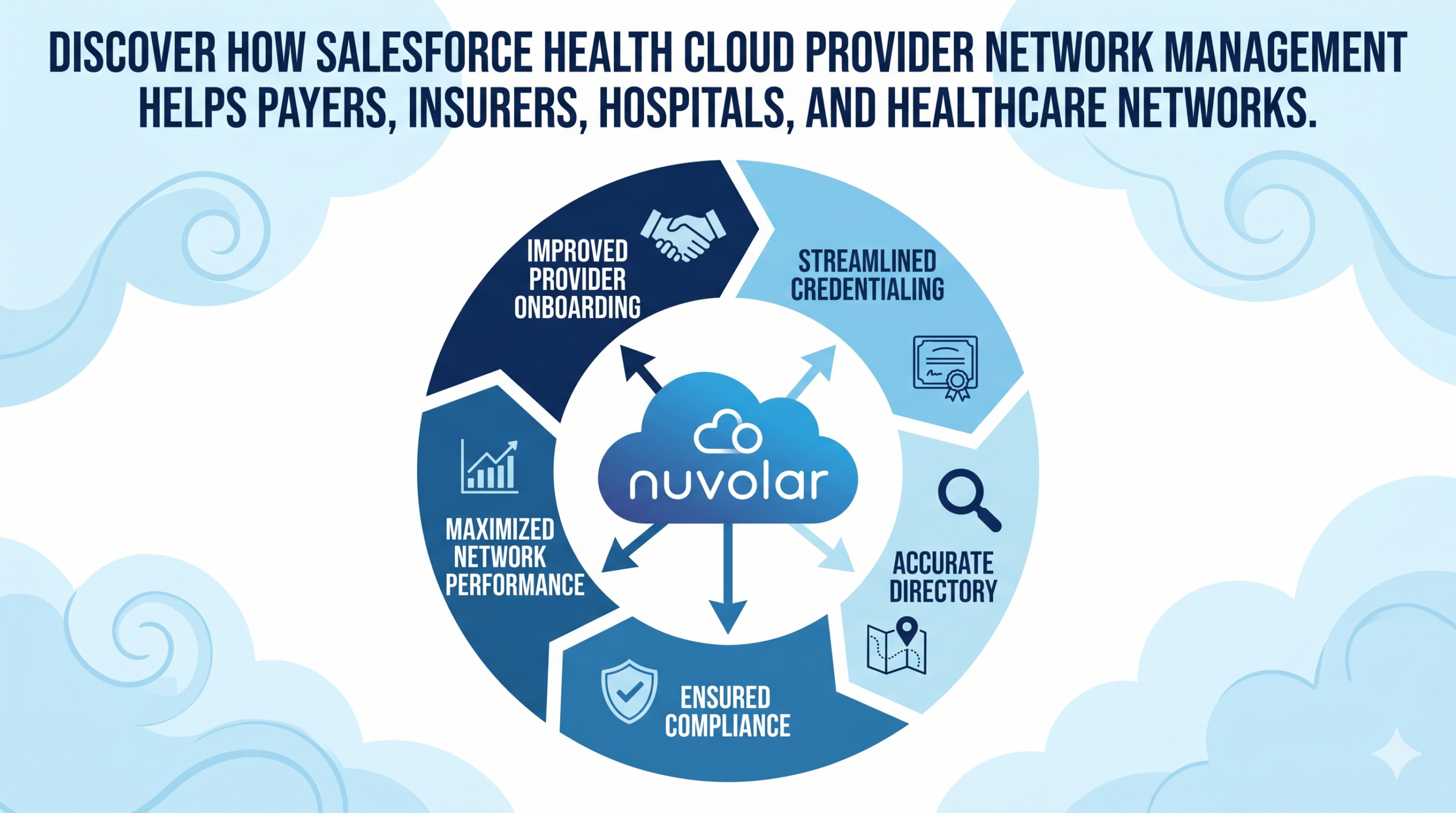
Salesforce frames this tool as part of Health Cloud, aimed at helping payers and provider groups bring providers on board, shape workable networks, and keep the stronger performers connected over time. Recruiting, credentialing, contracting, onboarding, self-service options, and network adequacy checks all sit inside that same space.

Table of Contents

What Is Health Cloud Provider Network Management?

Health Cloud Provider Network Management itself amounts to a Salesforce setup made for healthcare groups that oversee provider ties from start to finish. Instead of juggling spreadsheets, scattered emails, separate portals, and manual cycles for pay or contracts, teams can gather provider details onto one platform in the cloud.

The Unified Healthcare Flow

Healthcare staff can handle a comprehensive range of operational steps all in one flow:

  • Recruitment and enrollment

  • Credentialing and verification

  • Contracts and records

  • Network ties and affiliations

  • Directories and location details

  • Self-service updates from providers

  • Adequacy checks

  • Performance tracking

  • Compliance steps

The Provider Data Model

The provider data model inside Salesforce Health Cloud pulls together complex data layers to create a steadier base for searching providers, managing relationships, and running network operations without constant guesswork:

Data Layer Managed Elements
Individual Profiles Practitioners, specialties, education histories
Credentials & Compliance Certifications, licenses, renewal dates
Network & Operations Payer networks, facility networks, affiliations, locations

The Challenge of Fragmented Provider Data

Provider networks rarely stay simple. One practitioner might split time across several facilities, join multiple payer networks, carry different specialties, and need ongoing updates to credentials.

When the information sits in pieces, the effects spread across the whole system:

  • Outdated directories show up often.

  • Onboarding slows to a crawl.

  • Credentialing turns into a drawn-out manual task.

  • Contracting stays disconnected.

  • Gaps in the network stay hidden until they cause problems.

  • Proving adequacy grows harder.

  • Members and patients notice the friction.

  • Administrative costs climb.

Directory accuracy touches compliance and trust at the same time. Wrong details can limit access to care, raise costs, and wear down patient experience. Studies have shown how much administrative load falls on practices when they answer update requests from many health plans, each with its own platform and schedule.

Key Benefits of a Centralized System

A Centralized View of Provider Relationships

Organizations see providers, facilities, specialties, licenses, affiliations, contracts, and interactions together. Teams in provider relations, operations, compliance, contracting, and member services end up working with fewer blind spots.

Accelerated Enrollment and Onboarding

Provider enrollment and onboarding move faster once automated workflows, digital forms, document collection, and task routing replace the old manual steps. Delays shrink, and providers encounter a smoother start.

Simplified Credentialing and Compliance

Tracking benefits when required documents, certifications, licenses, approvals, and renewal dates live in one spot. Health plans, hospitals, integrated delivery networks, dental groups, behavioral health networks, and specialty organizations all find this tracking useful.

Accurate, Up-to-Date Directories

Directories stay closer to accurate when providers can update their own information and data connects across workflows. Names, addresses, specialties, availability, locations, and network status hold up better over time. Members locate care with less hassle, and regulatory needs get met more easily.

Real-Time Network Visibility

Real-time visibility into the network lets leaders spot strengths and gaps more quickly. They can check provider availability by area, specialty coverage, facility participation, credentialing status, contract details, adequacy measures, and performance trends. Planning improves, decisions speed up, and member access gets better as a result.

How Different Organizations Use the Platform

  • Health Plans: Handle enrollment, credentialing, contracts, participation, directory updates, and member search in one place.

  • Provider Groups & Healthcare Systems: Gather practitioner records, facility ties, licenses, specialties, locations, and operational steps centrally, cutting down on duplicated work and strengthening data governance.

  • Hospitals & Integrated Delivery Networks: Track employed providers, affiliated physicians, facilities, departments, and specialty networks to support better care access and referral handling.

  • Specialty Networks (Dental, Vision, Behavioral Health): Gain structure for complex credentialing, location, availability, and directory needs, raising day-to-day efficiency.

  • Self-Service Portals: Allow providers to update details, submit documents, and check status via dedicated portals. This lifts provider satisfaction while lowering manual effort on the payer side.

Compliance, Regulations, and Legacy Risks

Network adequacy and directory accuracy remain central concerns under regulations that push health plans to keep provider information current and reliable. The No Surprises Act adds specific obligations around directories, including corrective steps within set timeframes after issues surface. Health Cloud shifts the approach from reactive fixes to ongoing, connected management of records, approvals, workflows, and reports.

The Operational Risk of Legacy Systems

Legacy systems, spreadsheets, and email inboxes still handle provider data in many organizations, which builds operational risk. Duplicates appear, credentialing drags, directories fall out of date, onboarding stalls, reporting stays limited, compliance gaps widen, and providers grow frustrated. A modern platform supplies one reliable source that supports automation, reporting, and digital engagement as needs grow.

Best Practices for Implementation

Putting Health Cloud Provider Network Management in place involves more than technology alone. It calls for process knowledge in healthcare, Salesforce architecture, data planning, integration work, automation setup, and change management.

Nuvolar AI works with healthcare and life sciences groups to shape and roll out Salesforce solutions that link people, data, and workflows.

Our comprehensive support services cover:

  • Health Cloud implementation & Provider Network Management setup

  • Provider data model design & legacy system integration

  • Credentialing automation & data migration quality efforts

  • Experience Cloud for self-service provider portals

  • AI-driven workflow improvements

  • Broader healthcare CRM consulting and managed services

Final Thoughts

Provider networks sit at the core of access to care. When data stays inaccurate, scattered, or handled manually, payers and healthcare groups deal with higher costs, slower processes, compliance strain, and weaker member experiences.

Health Cloud Provider Network Management supplies a current method for handling provider relationships, credentialing, contracting, directory accuracy, and network visibility from one platform. For payers, hospitals, provider groups, and specialty networks, this reaches beyond a simple CRM upgrade. It points toward smoother operations, stronger provider experiences, and care that stays more reachable.

If an organization wants to update onboarding, credentialing, directory management, or network visibility, Nuvolar can outline and build the fitting Health Cloud solution.

📞 Schedule a Discovery Session