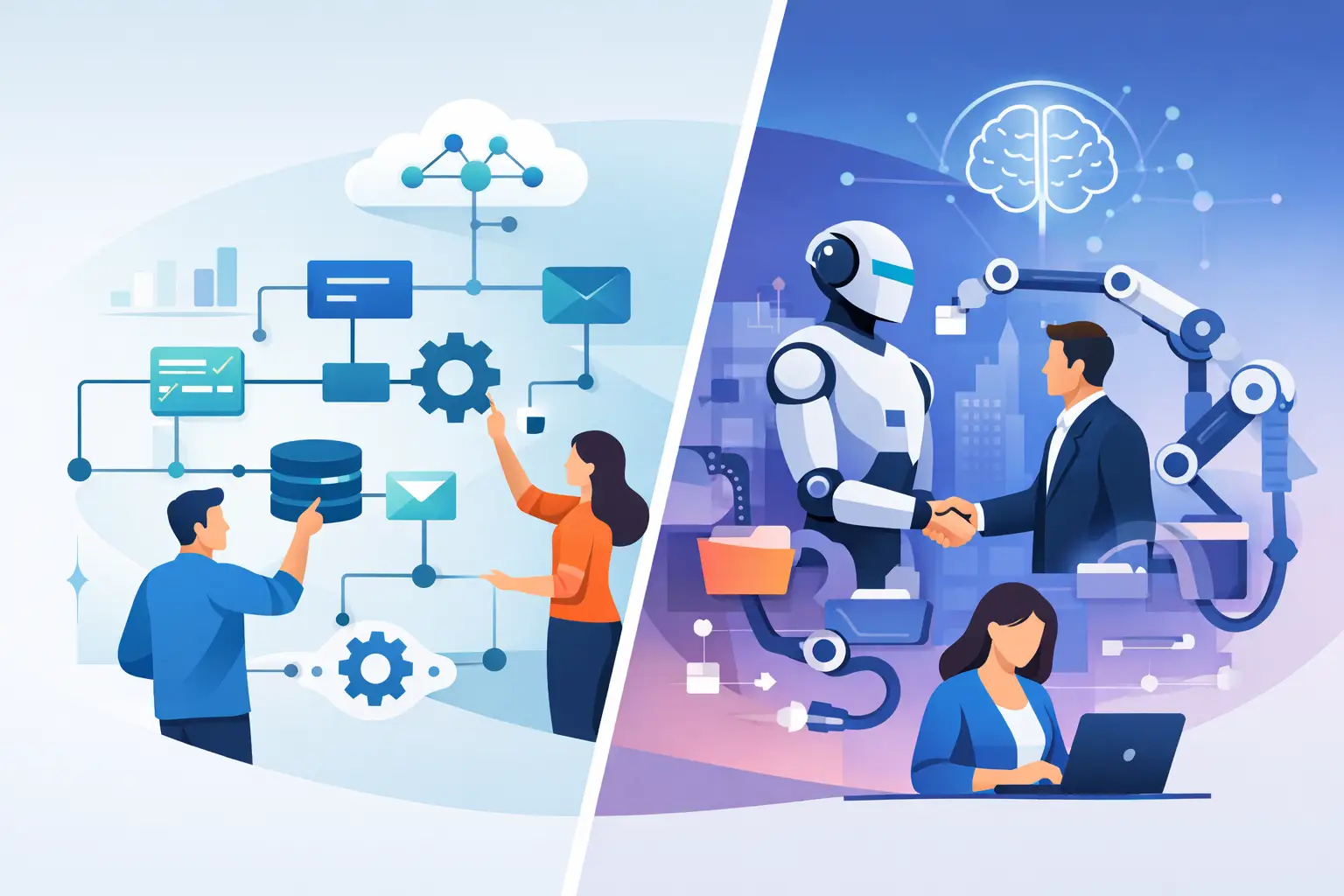
Workflow Automation vs RPA for Complex Teams

A ‌claims ‌team ‌might spend its day retyping policy information from a customer portal into an old underwriting platform. Meanwhile, sales operations could be busy steering opportunities, switching account owners, and chasing approvals that bounce between the CRM, finance, and contract systems. Both are repetitive, sure, but they don’t call for the same kind of automation. That’s the real line between workflow automation and RPA: one is built to coordinate work across people and systems, the other is usually about copying what an individual user does on a screen.

For transformation leaders, lumping them together tends to backfire, higher costs, fragile fixes, and adoption that never really sticks. What you pick should come from the nature of the process: which systems are involved, how much judgment is needed, and what kind of operating model you’re trying to put in place over time.

Workflow Automation vs RPA: The Core Difference

Workflow automation is about running a business process end to end using rules, events, approvals, and data. The point is to keep work moving. Someone submits a request, required fields get checked, ownership gets assigned, notifications go out, approvals are gathered, and the final result is recorded in a way you can audit later.

RPA, robotic process automation, is different in spirit. It relies on software bots that handle repetitive, rules-driven tasks a person would otherwise complete through a user interface. A bot can sign in to an application, pull values from a spreadsheet, fill fields in a legacy system, create a report, or match records across tools.

This isn’t only a technical distinction. Workflow automation is typically process-first: how should the work be designed, governed, and measured across the organization? RPA is task-first: which manual clicks and keystrokes can a “digital worker” perform the same way every time?

Employee onboarding makes the contrast easy to see. A workflow can coordinate HR, IT, facilities, payroll, and compliance so each group knows what it owns and everyone can see progress. But an RPA bot can still be useful, say, to create the employee record in an older payroll system that doesn’t integrate cleanly. Together, they can be a strong solution. Without an intentional design, though, they can also speed up the wrong process and spread confusion faster.

Where Workflow Automation Creates Strategic Value

Workflow automation shines when you need consistent execution across departments, platforms, or regions. It’s especially helpful for processes with handoffs, approvals, exceptions, service-level commitments, and compliance obligations.

In healthcare or life sciences, that could look like routing an adverse-event report to the right clinical and regulatory owners while keeping a full audit trail. In financial services, it might be customer onboarding, document checks, risk review, escalation paths. In manufacturing, it could be moving a quality issue from detection to investigation, corrective actions, and closeout.

The upside goes beyond fewer manual steps. A well-built workflow creates operational clarity. You can see where requests get stuck, which teams are overloaded, where exceptions keep appearing, and whether policy controls are actually being followed. That matters because plenty of process failures aren’t about effort. They come from split ownership, missing information, and systems that don’t share context.

Platforms like Salesforce and Zoho can become strong workflow foundations when they’re set up around how the business really operates, not around generic templates. Connect them carefully to ERP, service tools, data platforms, and communication channels and the value compounds. The aim isn’t to automate a single form. It’s to create a connected process employees can follow and leaders can manage.

Where RPA Is the Better Fit

RPA is often the pragmatic move when the work depends on legacy apps, desktop software, or third-party portals that don’t offer usable APIs. Many companies still run on systems that are critical and hard to integrate. Replacing them can take years, and bots can take pressure off while modernization is in progress.

Picture a transportation company pulling shipment updates from multiple carrier portals. If there’s no reliable system-to-system connection, an RPA bot can grab status data on a schedule and push updates into the operations platform. Or think of an insurance team moving standardized information between a document repository and a policy administration system. When the fields and steps are consistent, RPA can do the transfer quickly and repeatably.

RPA also works well for high-volume, stable tasks where the process is already clear. It can boost throughput, cut data-entry mistakes, and free people up for customers, analysis, or the messy exception cases.

Still, RPA shouldn’t replace a real integration plan. Bots depend on screens, so small changes in layouts, login steps, field names, or permissions can break them. If the process shifts often or relies heavily on human judgment, maintenance costs can climb fast. In some cases, a bot ends up hiding a deeper issue that belongs at the workflow or platform level.

The Trade-Offs Leaders Need to Evaluate

A good workflow automation vs RPA decision usually isn’t about picking one category and calling it done. It’s about choosing the right method for the process you have today, along with its constraints and maturity.

Workflow automation generally demands more design work early on. Ownership has to be clear. Business rules, exception paths, approvals, and data responsibilities need to be spelled out. That can feel slower at first, but it often leads to something that scales and stays understandable.

RPA can move faster for narrow tasks, especially when APIs don’t exist. But that speed should be weighed against ongoing monitoring, change management, security controls, and handling what happens when the bot hits something unexpected. Saving ten hours a week looks great until the bot breaks whenever a vendor tweaks its portal.

Governance matters, too. In regulated environments, automation has to support traceability, access controls, data protection, and decisions you can defend. Workflow platforms usually provide structured records for assignments, approvals, and outcomes. RPA programs need the same discipline around bot credentials, privileged access, logging, and recovery.

AI adds still another layer. Intelligent document processing, natural-language classification, and predictive models can strengthen both workflows and bots. The key is to use AI where it improves an actual decision or removes meaningful friction, not as a flashy add-on. For example, an extraction model can classify incoming correspondence, while a workflow routes low-confidence cases to trained reviewers. You keep speed without giving up oversight.

A Practical Way to Choose

Begin with the process, not the tool. Map the current state far enough to understand the trigger, inputs, systems, handoffs, decisions, exceptions, and the end result. That exercise often shows that what looked like one automation project is really a few separate problems hiding under one label.

Workflow automation is usually the better first move when the process spans teams, needs approvals, requires shared visibility, or benefits from a system of record. It’s also the stronger option when APIs or native platform features can connect systems in a dependable way.

RPA is usually the better first move when the work is highly repetitive, rules-based, and carried out in applications that can’t be integrated well. It’s particularly useful as a bridge while a broader modernization effort is underway.

For a lot of organizations, the cleanest design is hybrid. A workflow engine manages the overall process, user experience, controls, and reporting. RPA handles a specific legacy-system step inside that flow. APIs connect systems wherever they can. AI supports classification, extraction, or recommendations when confidence thresholds and human review are clearly defined.

That way, you’re not forcing every need into one platform. It also makes the automation landscape easier to adapt as systems get replaced, policies evolve, and operating models mature.

Build for Change, Not Just Today’s Bottleneck

Automation projects usually start with a real pain: approvals that drag, service teams overloaded, duplicate entry, compliance backlogs. Those are sensible places to begin. The strongest programs, though, don’t measure success only in hours saved. They ask whether work has become more dependable, easier to see, and simpler to improve.

Getting there takes clear process ownership, a user experience people won’t fight, integrations that behave consistently, and a support model that holds after go-live. It also takes the willingness to retire workarounds instead of automating them forever.

Nuvolar approaches this as technology with intention: process, data, platforms, and human handoffs designed as one connected environment. The useful question isn’t which is better in the abstract, workflow automation or RPA. It’s whether each piece helps the organization make the next operational decision faster, with more confidence and better control.

Best Workflow Tools for Complex Teams

Workflow Orchestration: How to Choose the Right Platform

A delayed claim approval or incomplete maintenance log or sales handoff lost between platforms rarely traces back to one team alone. What surfaces instead is a workflow issue, people and policies and data and decisions moving across separate systems with scant visibility into the actual flow. Strong enterprise tools tackle that gap directly. Yet choosing one goes beyond scanning feature lists for the longest entries.

For leaders the deeper question is this. Can the tool sharpen execution without creating another silo or compliance burden or reliance on scarce technical staff. The answer depends on the workflows involved, the systems that must connect, and the governance level an organization needs so change does not simply come undone.

Enterprise workflow technology should do more than pass tasks between inboxes. It needs to make work measurable and accountable while remaining adaptable. In regulated fields like healthcare or finance or manufacturing or transport that requirement also includes keeping audit trails whole, holding access controls steady, and applying process logic consistently each time.

Leading platforms often combine process orchestration with business rules, approvals, notifications, integrations, reporting, and role-based views. Those elements weigh differently based on the problem at hand. Revenue operations might focus on CRM-native steps and lead routing. An IT service group looks for incident flows, asset context, and enterprise service management. Claims or patient or quality teams frequently require case handling with clear exception paths.

This distinction counts because tools get compared as if interchangeable. They are not. Some excel at automation across SaaS tools. Others target large-scale case work, process modeling, or document-heavy flows. The right match comes from aligning both process complexity and the operating model that supports it.

Comparing Leading Enterprise Workflow Platforms

1. Salesforce Flow

Salesforce Flow fits when customer or partner or service or revenue flows already live inside Salesforce. Teams automate record updates, approvals, notifications, guided actions, and integrations without leaving that space. Organizations handling complex sales operations, service delivery, partner programs, or regulated customer steps often see better adoption and data quality when logic stays close to the customer model.

The trade-off sits in architecture. Flow works best when Salesforce serves as the main operational hub. It can link into wider enterprise automation, yet companies with scattered systems may still need an integration or orchestration layer beside it. Governance counts here too. Flows left unmanaged grow tangled quickly once teams and requirements multiply.

2. ServiceNow

ServiceNow suits groups that want disciplined workflows across IT, employee services, security, operations, and customer service. Its edge lies in standardizing request, incident, change, and service delivery steps while linking them to configuration data, knowledge bases, and service-level tracking.

It stands out when a business aims to turn fragmented service experiences into one governed model. Employee onboarding offers a clear case: IT provisioning, HR tasks, access approvals, and facilities requests coordinated in a single view. The platform can expand in reach and expense, so it suits organizations prepared to commit to process ownership, platform oversight, and ongoing refinement.

3. Microsoft Power Automate

Power Automate tends to emerge as the choice for enterprises already aligned on Microsoft 365, Dynamics 365, Teams, and Azure. Business and IT groups automate approvals, document tasks, notifications, data movement, and departmental flows through accessible low-code options.

Its value rises when needs span wide ground yet stay uneven in complexity. Teams reduce manual steps quickly. IT retains levers for security, data policies, and deeper Azure ties. The risk remains sprawl. Without a center of excellence, automations built by separate teams accumulate, duplicate logic, blur ownership, and produce uneven controls. It performs better under defined design standards and a maintained inventory of production workflows.

4. Appian

Appian suits high-stakes processes that cross multiple systems, human decisions, documents, and exceptions. It often appears in financial services, life sciences, public sector, and insurance settings where case management and process visibility matter as much as automation speed.

The platform supports low-code development, process modeling, data integration, and intelligent document handling. Its real strength is coordinating an entire operational process rather than simply moving one task. That proves useful for complex cases, though it calls for careful solution design and solid process thinking. A process that lacks definition does not gain clarity merely by being modeled in a capable tool.

5. Pega

Pega shows strength for organizations handling large volumes of customer interactions, cases, and policy-driven choices. It combines workflow automation with case management, business rules, and decisioning. Insurers, banks, healthcare groups, and service operations that require consistent decisions across channels often find it relevant.

Pega does not serve as a quick patch for isolated hiccups. It delivers when complex, repeatable processes demand that decisions, compliance, and customer context align. Success requires maturity in process ownership and change management, yet the scope can support real operational shifts.

6. Camunda

Camunda fits when workflow orchestration must sit inside modern, distributed software architectures. Built on open standards, it sees use by engineering teams that build services coordinating long-running processes, exceptions, and events across applications.

Unlike platforms aimed at business users, Camunda assumes a capable technical team. That becomes an advantage when an enterprise needs flexibility, portability, and control over intricate orchestration. It fits less well when business teams expect to design and adjust flows with little engineering input.

7. Workato

Workato centers on connecting applications and automating work across business systems. It helps when the immediate issue is reliable exchange between CRM, ERP, HR, support, finance, and data platforms. Recipes and integration features reduce manual handoffs that create delays and data mistakes.

For cross-functional processes it can act as a useful connective layer. Integration automation still differs from full business process management. When a workflow involves heavy human casework, tangled exception routes, or deep policy oversight, Workato may need a dedicated workflow or case platform alongside it.

Evaluation Framework: A Strategic Blueprint for Platform Selection

Step-by-Step Selection Strategy

1. Begin with a process rather than a product category. Choose two or three workflows where delay costs, rework, noncompliance, or weak customer experience stand out.

2. Map the current state across people, systems, handoffs, decisions, and exceptions. That mapping shows whether the core need is task automation, application integration, service management, case management, or end-to-end orchestration.

                  ┌──────────────────────────────────────────────┐
                  │ Map Current State Across People & Systems    │
                  └──────────────────────┬───────────────────────┘
                                         │
                 ┌───────────────────────┴───────────────────────┐
                 ▼                                               ▼
     [Task & App Integration]                        [Full Case Handling]
   (Workato / Power Automate)                     (Appian / Pega / ServiceNow)


Measure any platform against four practical angles:

  • Process complexity: Covers exception paths, decisions, documents, and participants.

  • Integration demands: Addresses systems of record and real-time data ties.

  • Governance needs: Includes security, auditability, version control, and ownership.

  • Change capacity: Considers whether business teams, IT teams, or a shared model will sustain the solution.

Treat low-code as no excuse to skip architecture. Low-code speeds delivery and brings domain experts nearer to building. Enterprise workflows still need reusable patterns, testing, release management, documentation, and clear accountability. The quicker a team builds, the more those controls matter.

Measuring Impact and AI Readiness

Effective workflow programs set a measurable baseline before starting. Track cycle time, manual touches, exception rates, approval delays, backlog volume, and customer or employee outcomes. Such metrics help leaders separate automation that merely accelerates work from improvements that remove unnecessary steps.

They also prepare the ground for AI. Intelligent document processing, predictive routing, agent help, and generative summaries add value when the underlying workflow already has defined inputs, decisions, escalation paths, and controls. Apply AI to an undefined process and inconsistency simply moves faster and grows harder to audit.

Partnering for Long-Term Execution

A technology partner can turn operational pain into architecture that matches the organization instead of forcing the organization to bend around a tool. At Nuvolar that involves blending human insight, platform knowledge, integration design, and governance to build technology with purpose.

The right platform should make complex work simpler to grasp and refine. Select the one that offers teams a dependable route from process visibility to accountable, scalable execution.