07 Jul, 2026
- 7 min
 07 Jul, 2026
 7 min
7 min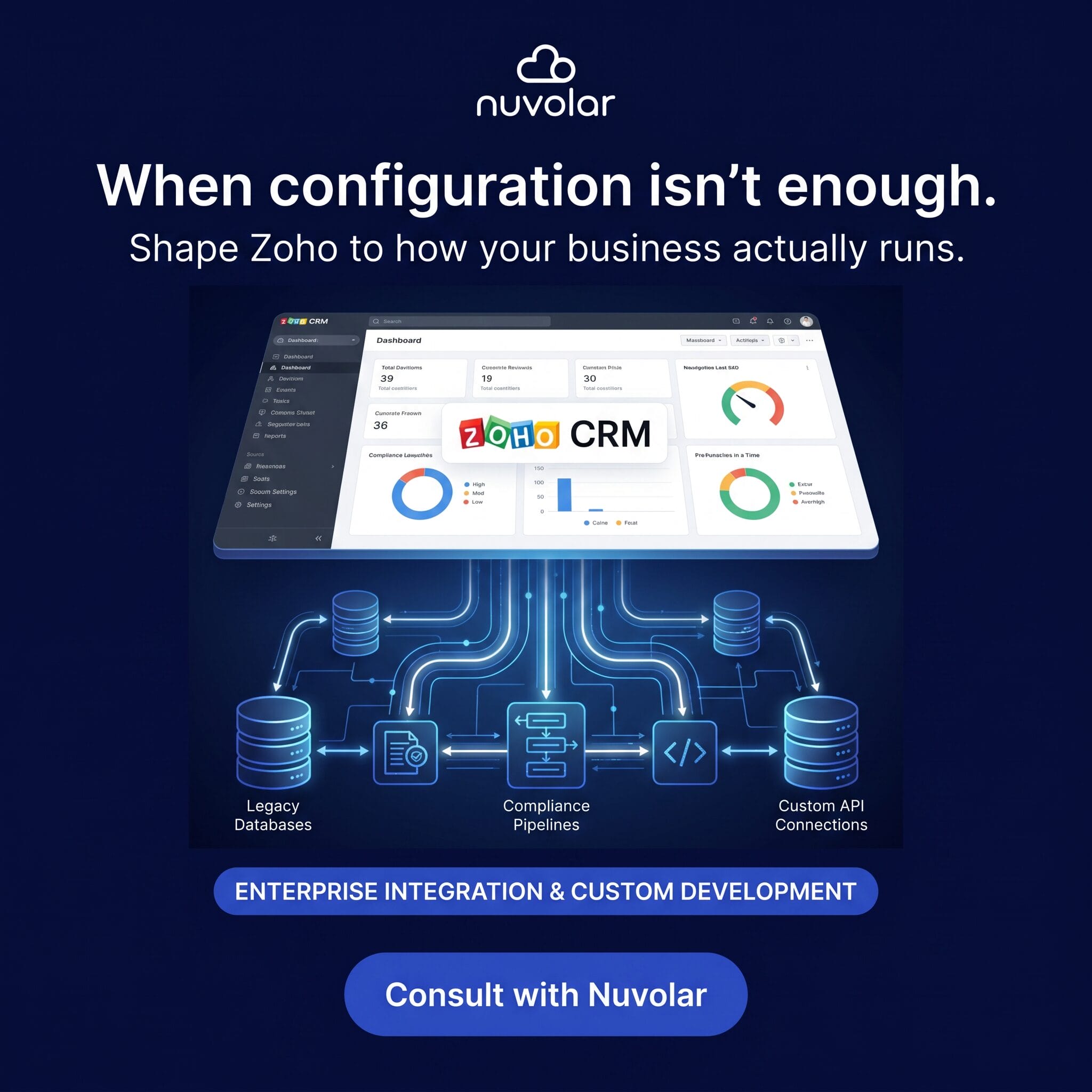
The Strategic Reality of Zoho Development: From Configuration to Execution Zoho looks simple on the surface yet your operation rarely stays that way. Configuration runs its course at some point. Then zoho development turns from a technical checkbox into a real business decision. Mid-market teams and enterprise groups handling compliance, multi-step workflows, legacy systems, cross-functional data, all face the same truth. The value lies not in piling on more tools but in shaping Zoho around how work actually happens.
Zoho earned its spot by spanning a broad operational footprint. CRM, finance, customer service, analytics, marketing, custom apps, automation, all sit inside one environment. Transformation leaders confront a sharper question though. It is not whether Zoho offers features. It is whether those features deliver the precision teams require without adding new friction.
What zoho development actually means
Zoho development means extending, adapting, integrating the platform beyond basic setup. Custom functions, bespoke modules, tailored interfaces, API-based integrations, data architecture, role-based permissions, workflow orchestration, custom applications built in Zoho Creator.
Practically this is how a sales process carrying complex approval logic gets modeled correctly. How service teams see the right data at the right moment. How finance, operations, commercial teams stop working from conflicting records. How platform owners avoid the slow drift that turns a promising implementation into another underused system.
Why does any of this matter?
Most operational headaches do not stem from a missing button. They stem from mismatches between software design and business reality. When the platform fails to reflect your processes people create workarounds. Workarounds turn into risk, lost visibility, inconsistent execution.
Where standard Zoho setup starts falling short
Straightforward use cases benefit from native configuration. A growing company with a simple pipeline and limited integration needs often finds standard modules, predefined automation, a few dashboards sufficient. That is fine. Not every organization requires heavy customization.
The equation changes once multiple business units enter the picture. Region-specific rules. Regulated data. A service model that crosses departments. Standard setup then feels too rigid in one area, too loose in another. Teams cannot enforce process discipline or they get pushed into awkward exceptions that undermine adoption.
A healthcare organization needs different visibility rules for clinical, operational, commercial users. A manufacturer needs CRM data tied to order status, support history, field activity. Aviation or insurance teams need auditability and workflow controls that standard configuration cannot fully deliver. In each case zoho development lets the organization align the platform with operational reality rather than asking the business to simplify itself for the software.
The business case for custom development
The strongest case for development is rarely about adding complexity. It is about removing complexity for users while increasing control for the business.
Well-executed customization shortens handoffs. It reduces manual entry. It improves forecasting. It gives leadership a more reliable view of performance. It strengthens governance as well. Approval rules, validation logic, system permissions designed with intention mean teams make fewer avoidable errors and compliance teams gain confidence in the process.
Customization is not automatically the right move. Too much of it makes future changes harder especially if the design stays reactive and poorly documented. The goal is not to customize everything. The goal is to customize what materially improves execution, data quality, scale.
That is where experienced delivery matters. A strategic partner will challenge requests that simply reproduce inefficient legacy behavior inside a new platform. Sometimes the better answer is process redesign. Sometimes a lightweight integration. Sometimes a custom app is justified because the business model is genuinely distinctive. It depends on operational and commercial impact.
Key areas where zoho development creates value
CRM aligned to real revenue operations
Many CRM deployments fail quietly. The platform is live, dashboards exist, users log activity yet the system does not accurately represent how deals move, who owns what, where revenue risk sits. Development helps close that gap. Custom modules, guided processes, automated stage transitions, quote logic, account hierarchies, all support a more reliable operating model. Revenue leaders get better pipeline visibility and less dependency on manual interpretation. Front-line teams get fewer clicks and clearer next steps.
Integrations that reduce data fragmentation
Most enterprise environments are not greenfield. CRM needs connecting with ERP, billing, support, marketing, document management, data warehouses, sector-specific tools. Without those connections users waste time switching systems and reconciling records. Zoho development makes integrations useful rather than superficial. The difference matters. Passing data from one platform to another is not the same as designing trustworthy sync logic, exception handling, ownership rules, reporting consistency. Treat integration as a checkbox and the business inherits hidden failure points.
Custom apps for operational edge cases
This is where Zoho Creator often enters the conversation. When a business process does not fit standard CRM or service tooling a custom application fills the gap without forcing a separate ecosystem. It proves valuable for inspections, field workflows, internal requests, onboarding, inventory-related processes, regulated review cycles. The advantage is not only speed. It is proximity to the wider Zoho environment. Data moves more intentionally across systems which strengthens reporting and governance.
Automation with control
Automation attracts attention for obvious reasons yet it creates confusion if layered onto an unclear process. Strong development begins by defining logic. What should trigger. Who gets notified. What data gets updated. Where human review remains necessary. This becomes particularly relevant in regulated or high-risk environments. Full automation is not always desirable. Sometimes the right design includes checkpoints, escalation paths, audit trails. Smart systems are not the ones with the most automation. They are the ones where automation supports judgment rather than bypassing it.
How to approach Zoho development without creating future debt?
Most effective projects start with operating model clarity. Before building anything teams need a grounded view of current workflows, pain points, user roles, data dependencies, business rules. It sounds obvious. Many platform initiatives still begin with feature requests instead of process understanding.
From there architecture decisions should consider scale:
Object Architecture: Which objects should be native, which custom.
Data Residency: Where should data live.
Sync Logic: What must sync in real time, what can update in batches.
Governance: How will permissions evolve as the organization grows.
Separating must-have development from nice-to-have customization helps as well. Early wins matter especially when adoption has been uneven or the business needs proof of value fast. A phased roadmap often works better than a large all-at-once build. It lowers risk. It gives teams room to learn from real usage.
Testing deserves more attention than it usually receives. In complex environments workflows may behave differently across roles, regions, exceptions. If testing only covers the happy path issues appear after launch where they become more expensive and more visible. Good testing forms part of good governance.
Choosing the right partner for zoho development Technical capability is essential but not enough on its own. The real differentiator is whether a partner can translate between platform mechanics and business outcomes. Decision-makers do not need code for its own sake. They need systems that support growth, control, operational clarity.
A strong partner asks direct questions about process design, adoption barriers, reporting trust, integration dependencies. It stays comfortable with trade-offs. It knows when to build, when to configure, when to simplify. It thinks beyond launch as well. A platform working at go-live may still fail six months later if support, training, governance remain weak.
A long-term perspective matters especially for organizations working across multiple markets or complex industry requirements. Platform decisions made early either support future scale or quietly limit it.
Best zoho development does not call attention to itself. Users experience it as clarity, speed, fewer blockers. Leaders experience it as cleaner data, better visibility, systems keeping pace with the business. Teams outgrowing standard configuration. That is not a sign the platform is failing. It may simply mean the business is ready for more deliberate design. Nuvolar approaches this work as technology with intention, connecting delivery choices to the operating realities clients manage every day. Learn more about how to scale your ecosystem purposefully by partnering with the


You may also like…