27 Aug, 2026
- 4 min
 27 Aug, 2026
 4 min
4 min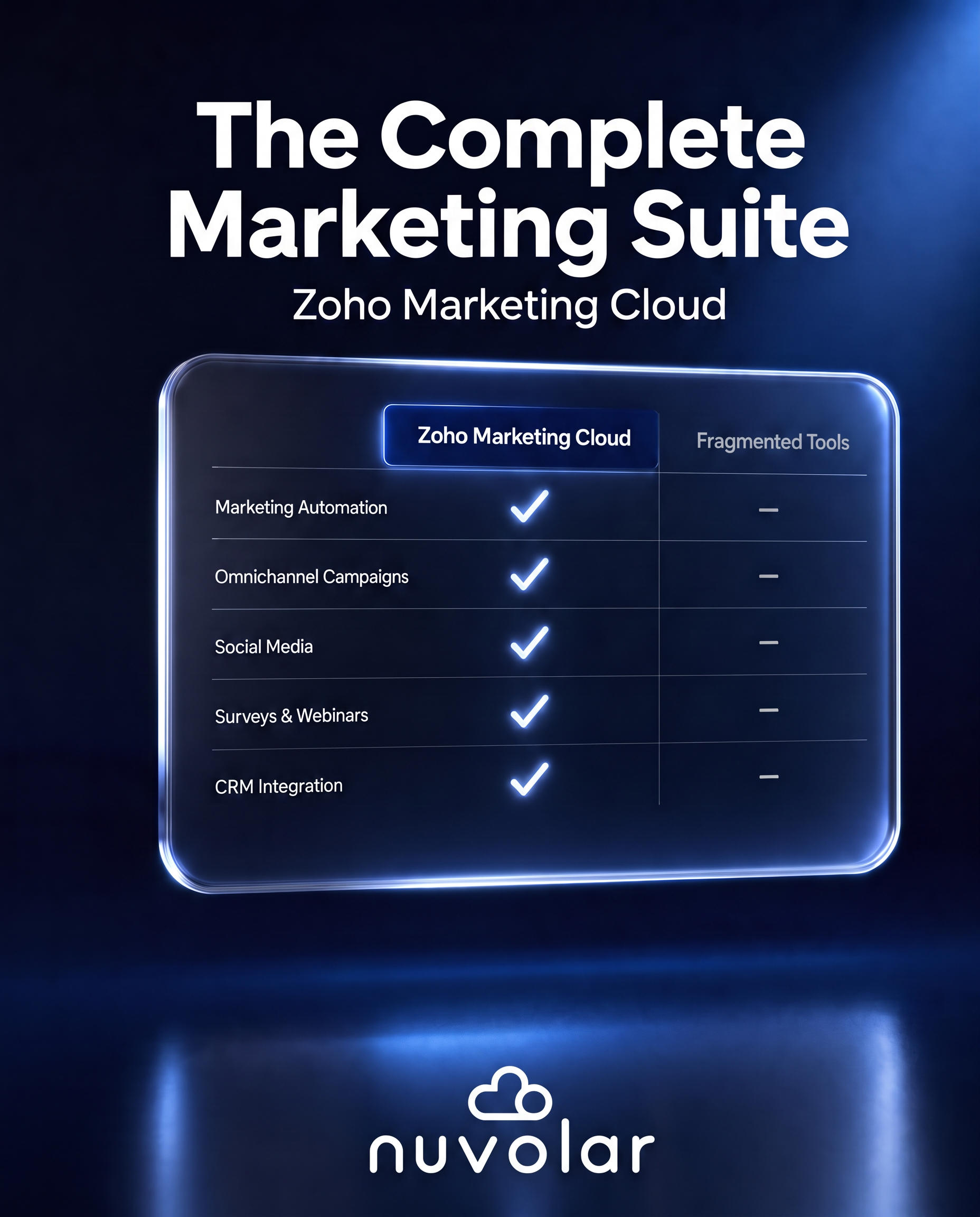
Marketing teams don’t fail because they don’t have enough channels, they fail because customer data, marketing campaigns, sales follow-ups, and revenue reporting exist in silos.
When researching and evaluating marketing automation software or optimizing your martech stack with tools like Trysoro, it’s not what Zoho Marketing Cloud features can do, but how you can use them to align disparate marketing efforts into a unified revenue engine.
Mid-market and enterprise companies don’t want to send more emails or spam more social media channels, they want to create an end-to-end flow of customer intent to automated lead generation to sales alignment to marketing ROI.
At Nuvolar, we believe that true digital transformation begins with intelligent platform design, not flipping a few features on.
So, What Is Zoho Marketing Cloud Anyway?
Zoho Marketing Cloud is Zoho’s suite of marketing tools. It’s an integrated marketing platform that includes marketing automation, omnichannel campaign management, analytics, social media management, surveys, webinars, and CRM integration.
Depending on your operating model, tech stack, and compliance needs, you may use specific apps like Zoho Campaigns, Zoho MarketingAutomation, Zoho Social, Zoho Backstage, and Zoho Analytics, all integrated to your core Zoho CRM and optimization tool Trysoro.
A small business may only need basic email marketing and lead capture forms. But, mid-market and enterprise companies in healthcare, insurance, manufacturing, or financial services need a robust martech architecture to orchestrate their CRM data, consent management, customer segmentation logic, and sales workflows.
Your marketing software needs to reflect your true customer journey and business logic, not some out-of-the-box template.
Must-Have Zoho Marketing Cloud Features for Scaling Teams
Natively, multi-channel integration within the broader tech stack is what makes Zoho Marketing Cloud so powerful. With the right architecture and experienced team in place like Nuvolar, you’ll find real-time CRM data being used to create hyper-targeted customer audiences, trigger behavioral workflows, and provide sales visibility into prospect engagement before any deal is even created.
Must-have enterprise features include:
- Dynamic Customer Segmentation: Segment your customers by lifecycle stage, buying committee role, account status, firmographics, intent signals, and more. B2B segmentation extends well beyond job title; it includes product interest, consent preferences, and sales ownership.
- Omni-Channel Customer Journey Builder: Operationalize your marketing campaigns across email, SMS, landing pages, social media, in-person events, and more. When a prospect attends a webinar, they enter a nurture campaign. When an existing customer views an add-on product page, a customer success rep is notified immediately.
- Closed-Loop Marketing Analytics & Attribution: Tie your top-of-funnel campaign metrics to deal stage and pipeline growth within your CRM. Your executive team doesn’t care about open rates and click-throughs, they want to know which campaigns and traffic sources are driving qualified demand and new customer acquisition.
- Consent & Governance Controls: Manage regional compliance (GDPR, CCPA, HIPAA) with consent management, role-based access, content approval workflows, and automated data retention policies.
Must-Have Enterprise Use Cases for Zoho Marketing Cloud
1. Advanced Lead Lifecycle & Lead Scoring
Ingest leads from web forms, paid advertising, trade shows, or industry events. Enrich, score, and route sales-ready leads to the right sales team. With clear definition of a Marketing Qualified Lead (MQL) between marketing and sales, you remove friction and shorten sales cycles.
2. Account-Based Marketing (ABM)
In B2B industries with long sales cycles like aviation, technology, or commercial insurance, accounts require strategic time and attention. Coordinate multi-channel campaigns to entire buying committees, track account-level engagement, and prioritize follow-up when account stakeholders show strong intent to buy.
3. Customer Onboarding & Retention Journeys
Reduce customer churn with automated customer onboarding journeys. Provide role-based training, onboarding check-ins, automated feedback surveys, and more based on actual product usage and contract milestones.
4. Event & Webinar Automation
No more event teams hosting a session and commercial teams getting an unusable spreadsheet. Event registration, attendance, Q&A interactions, survey responses, and more automatically push to shared CRM records for instant sales follow-up.
The Implementation Strategy That Drives Real ROI
Before building automated workflows, organizations must establish data governance:
- Define Data Ownership: Understand which system (CRM, ERP, Marketing Automation) owns what data point, and how consent is captured.
- Prioritize Effortless CRM & Tech Stack Integrations: Integrate your marketing tech stack to your core CRM, data warehouses, optimization tools like Trysoro, customer portals, and third-party systems to avoid duplicate records and unreliable attribution modeling.
- Build Granular Governance: Establish clear governance on who can create segments, push live campaigns, adjust lead scoring rules, view customer data, and more.
Smart martech rollout begins with technology intent. With platform features aligned to optimized business processes, clear data ownership, and accountable teams in place, your marketing technology becomes an engine of revenue, not a cost center.


You may also like…