06 Jul, 2026
- 8 min
 06 Jul, 2026
 8 min
8 min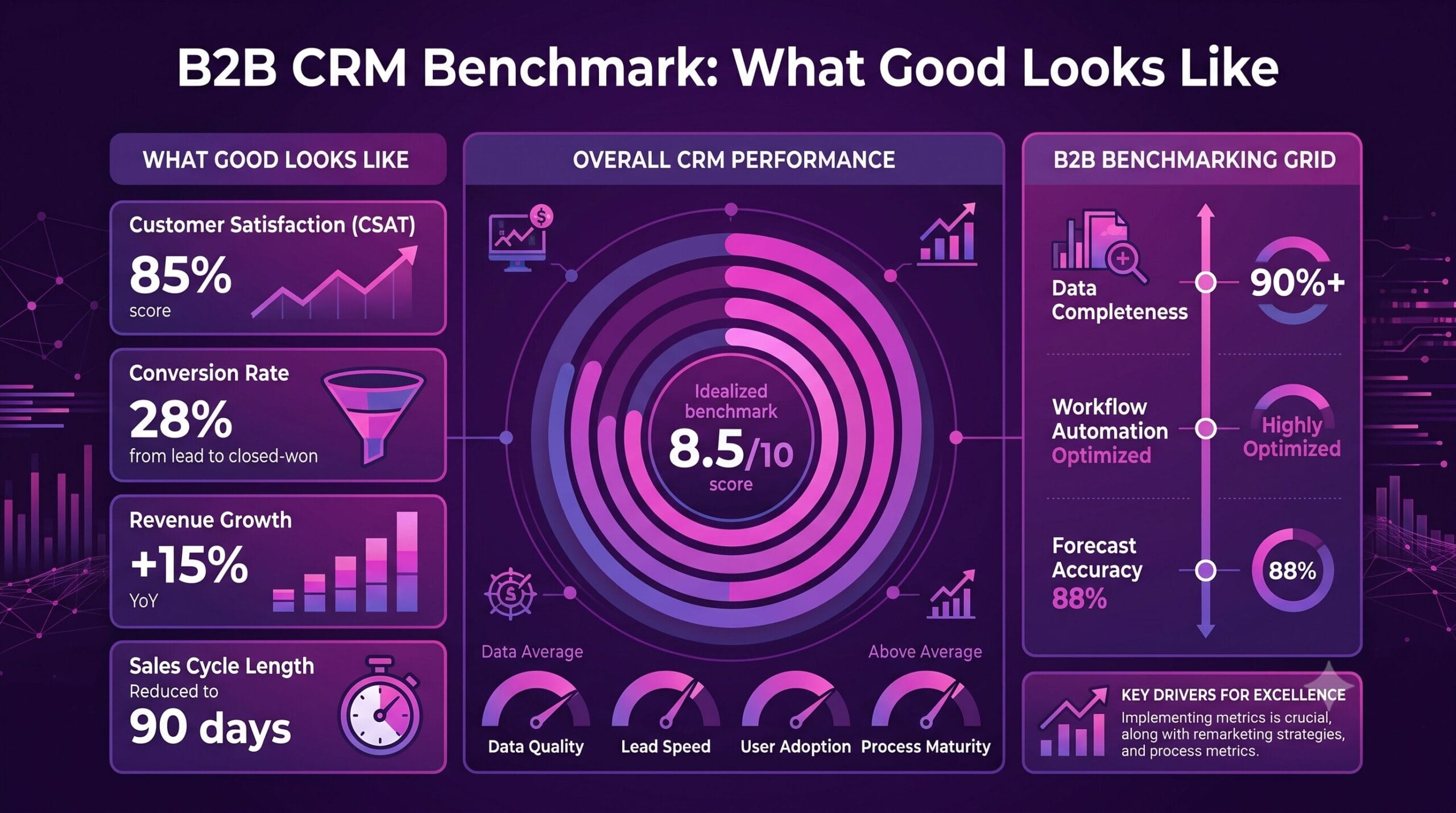
Most CRM problems do not start with the platform. They begin when leadership poses a reasonable question. Are we actually getting value from this system. A useful b2b crm benchmark helps answer that with evidence not assumptions. It shows whether your CRM is improving pipeline visibility sales execution service coordination and decision making. Or simply collecting records while teams work around it.
For mid market and enterprise organizations that distinction matters. CRM rarely stands alone anymore. It sits at the center of revenue operations customer service compliance workflows analytics and increasingly AI driven processes. When performance weakens the cost appears everywhere slower cycles unreliable forecasts duplicate work low adoption poor operational clarity.
What a B2B CRM Benchmark Should Actually Measure
A mature CRM benchmark avoids vanity metrics alone. Logging activity volume or counting contacts reveals very little by itself. The stronger path assesses CRM performance across five connected dimensions adoption data quality process execution commercial impact adaptability.
Adoption comes first as a signal yet it needs careful reading. High login rates can appear healthy while core opportunity stages stay incomplete or sales teams update records only before forecast calls. Real adoption means the CRM forms part of how work happens sellers trust it managers coach from it cross functional teams treat it as a shared operating layer.
Data quality forms the second dimension and it often reveals deeper structural issues. When account hierarchies stay inconsistent lead sources prove unreliable duplicates multiply or fields fill differently across regions reporting loses credibility fast. In regulated industries poor CRM data also creates governance and compliance risk.
Process execution counts just as much. A CRM can hold clean data and still underperform if workflows grow too rigid handoffs stay unclear or automations fail to match how teams actually operate. The benchmark should test whether the platform supports critical processes lead routing opportunity management approvals renewals case resolution partner collaboration without unnecessary friction.
Commercial impact draws executive focus. Is the CRM helping improve conversion rates shorten sales cycles increase retention strengthen forecast accuracy. The answer is not always immediate. CRM value often depends on surrounding process maturity. Still any enterprise benchmark should connect platform health to business outcomes.
The final dimension is adaptability. A CRM built for last year’s structure may not support today’s go to market model service model or data strategy. If every change requires excessive custom work user resistance or reporting workarounds the system may stay technically functional but strategically limiting.
Core Metrics That Make a CRM Benchmark Credible
A b2b crm benchmark gains usefulness when it combines behavioral metrics with outcome metrics. Looking at one without the other creates false confidence.
User adoption: Move past active users. Review role based adoption by sales service management operations partner teams. Measure record completeness by object stage progression consistency whether teams use the system in real time or retrospectively. A CRM updated days later is not a reliable operating system.
Data quality: Metrics should include duplicate rates missing critical fields invalid values account ownership gaps sync integrity across connected systems. If your CRM integrates with ERP marketing automation service platforms or finance tools the benchmark should also examine how often records fail to sync or create conflicting versions of the truth.
Pipeline health: Most organizations already track pipeline volume and stage conversion but benchmark quality comes from consistency. Are opportunity stages defined and used consistently across business units. Are close dates meaningful. Is pipeline aging visible enough to support action before deals stall. Benchmarking here often reveals whether CRM processes support sales discipline or mask weak execution.
Forecasting accuracy: Teams should assess forecast accuracy by manager region product line quarter. A CRM that supports accurate forecasting does more than store opportunities it enables structured judgment better data capture stronger management routines.
Automation performance: Review how much manual work remains in routing assignment approvals notifications quote support follow up tasks customer lifecycle triggers. More automation is not always better. Poorly designed automation creates noise and distrust. The benchmark should focus on whether automation reduces effort while improving consistency.
Service and post sale metrics: These belong in the conversation especially for account based or recurring revenue models. Case resolution times handoff quality renewal visibility customer health tracking these often separate organizations with a transactional CRM from those using it as a coordinated customer platform.
Why Benchmarks Fail Inside Enterprise Organizations
The most common benchmarking mistake compares one company to a generic industry average. That can mislead. A healthcare company managing compliance heavy workflows should not expect the same CRM behavior as a fast moving software business a global manufacturer with channel complexity will not benchmark the same way as a direct sales organization.
The better comparison lies between your CRM design and your actual operating model. If your sales motion is consultative long cycle multi stakeholder your benchmark should reflect that. If service quality and regulatory traceability matter as much as pipeline speed those priorities need weight in the assessment.
Another common issue treats platform limitations as the root cause when the real problem is governance. Poor ownership unclear field definitions inconsistent process training fragmented reporting logic can undermine even a well implemented CRM. In those cases buying more functionality will not solve the benchmark gap.
There is also the opposite risk over customization. Enterprise teams often respond to complexity by building layers of exceptions into the system. Over time that creates admin burden weak usability fragile reporting. A strong benchmark should highlight where customization supports business value and where it compensates for process ambiguity.
How to Run a Practical CRM Benchmark
Start with business priorities not features. If leadership focuses on forecast reliability commercial productivity or customer retention define the benchmark around those outcomes first. Then trace backward into the CRM behaviors data structures workflows that influence them.
Next segment the analysis. Benchmarking at a company wide level can hide important differences between teams regions business units. One sales organization may have strong adoption and weak data discipline while another has clean records and weak forecasting behavior. Segmenting helps you find the real operational patterns.
It is also worth combining quantitative review with stakeholder interviews. CRM dashboards can show low completion rates but they will not always explain why. Sometimes the issue is poor UX duplicated effort across systems missing mobile functionality a workflow that conflicts with how teams actually manage customer relationships. Human insight matters here.
Then assess integration architecture. Many CRM issues are not caused by CRM alone they come from fragmented surrounding systems delayed syncs weak master data management inconsistent business logic across platforms. If your CRM is expected to power analytics service coordination AI use cases integration quality has to be part of the benchmark.
Finally prioritize actions by impact and feasibility. Some issues can be fixed quickly through governance changes role based training field rationalization. Others require deeper platform redesign process reengineering integration work. A good benchmark does not just diagnose. It creates a decision path.
What Good Looks Like in Practice
A healthy CRM environment is usually less dramatic than people expect. It does not mean every dashboard is perfect or every workflow is automated. It means leadership trusts the data enough to make decisions from it users can complete critical tasks without friction the system can evolve as the business changes.
In practical terms good looks like clean and governed customer data clear opportunity management dependable forecasting useful automation reporting that reflects operational reality. It also looks like alignment between technology and process. Not a CRM forcing unnatural behavior. Not a business relying on spreadsheets to fill structural gaps.
For organizations with complex requirements the benchmark should also confirm that the CRM supports scale without losing control. That includes auditability role based access standardized workflows where needed flexibility to support business unit differences where they are justified. Technology with intention matters most when complexity increases. At Nuvolar, we always help you find the technology that best suits your company’s needs.
A mature benchmark is not a scorecard to impress stakeholders. It is a management tool. Used well it helps transformation leaders decide whether they need configuration improvements stronger governance smarter integration or a broader redesign of the customer ecosystem. That is where experienced partners like Nuvolar can create real value not by adding complexity but by aligning CRM architecture with business reality.
The most useful question is not whether your CRM is good or bad. It is whether it is credible enough to guide action. If your teams hesitate to trust the data challenge every forecast rely on side systems to do essential work your benchmark is already telling you where to look next.