01 Jul, 2026
- 6 min
 01 Jul, 2026
 6 min
6 min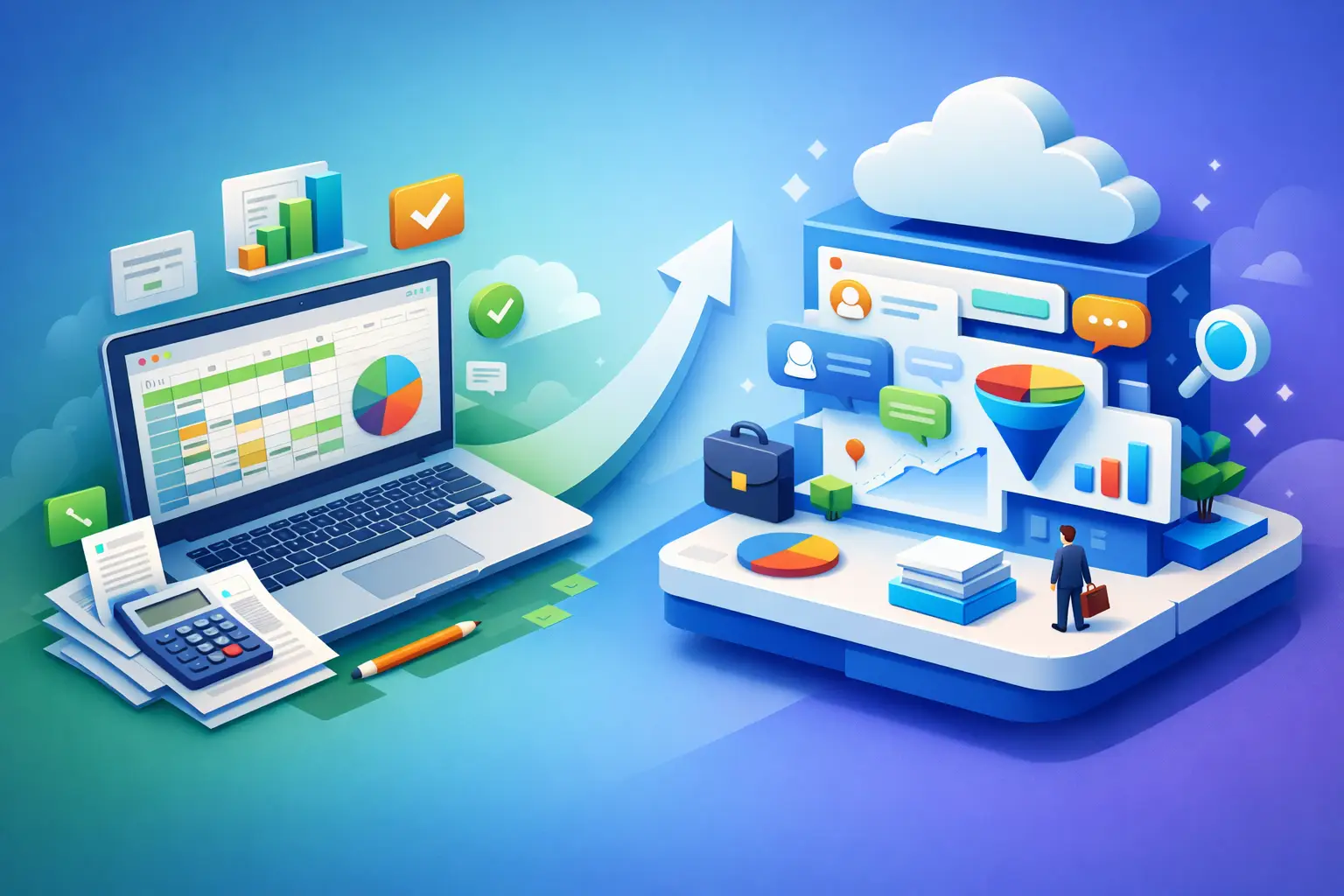
Most businesses begin in the exact same place: a shared spreadsheet. A couple of columns for leads and deals, maybe one tab per team. For a while, it does the job, then it stops doing the job.Excel is, frankly, impressive for what it is. You can put together a workable CRM, keep an eye on a pipeline, and even add some light automation around reporting.
In a small team, that kind of freedom helps. Still, freedom runs out. And companies usually hit that limit at the worst time, when the data is scattered across five files, nobody can say which one is “the real one,” and a rep in Madrid has no clue what the account team in Barcelona already promised the client.That’s not an Excel flaw. It’s what growth looks like, and it’s also the point where the right software starts paying for itself.
When does Excel’s real cost show up?
It’s rarely because Excel “breaks” (it’s a smart tool, and we still use it at Nuvolar too, just not as a CRM). The problem is the way it scale, and in the wrong direction: more tabs, more copy-pasting, more manual updates, more time spent in meetings trying to make numbers agree that should already be consistent. And this is happening a lot –> By the time leadership sees it clearly, the mess is already baked into forecasting, into pipeline reviews, into decisions.
This is where Salesforce Sales Cloud earns a seat at the table.
“1) Out of clutter find simplicity; 2) From discord find harmony; 3) In the middle of difficulty lies opportunity.”
― Marc Benioff, Behind the Cloud: The Untold Story of How Salesforce.com ( Link to the book)
Went from Idea to Billion-Dollar Company-and Revolutionized an Industry.
Not as a checklist of features, but as a decision you make once and stop revisiting every quarter: centralise how you run revenue, and make the data dependable enough to act on.Opportunity management, lead management, lead scoring, reporting, none of these are special on their own anymore. What makes them matter is having them together, connected end to end, and built around how your team actually sells.
What Sales Cloud needs to do in mid-market and enterprise
A CRM isn’t “contacts plus a dashboard.” Once you have real complexity, multiple territories, approvals that span stages, deal teams that cut across functions, the system has to mirror the business. The business shouldn’t have to contort itself to fit a tool.So you need territory models that match how your sales organisation is genuinely structured. Forecasting rules your sales leaders trust enough to put in front of the board. Approval flows that don’t depend on someone chasing a VP on Slack. And visibility that ties sales, ops, and customer teams together without the usual routine of exporting a report and emailing it around.When those fundamentals are right, people adopt the system because it makes their job easier. When they aren’t, even a great CRM becomes another thing everyone works around.
The features that actually change outcomesPlenty of CRM “comparisons” read like spec sheets. This isn’t that. These are the parts that tend to create real day-to-day improvement for growing sales teams.
Lead management and scoringEvery team has more leads than time. The real question isn’t whether you’ll prioritise, it’s whether you’re doing it on gut feel or on information you can defend.Salesforce lead management gives a structured way to capture, assign, and follow leads from first touch to qualified opportunity. Then Einstein lead scoring uses AI to surface the leads most likely to convert based on your own historical data, not generic benchmarks, but your patterns.For a mid-market team dealing with hundreds of inbound leads each month, prioritisation like that shows up fast, you can see the shift in pipeline quality within a quarter.
Opportunity managementThis is where deals actually live, and it’s also where spreadsheet setups tend to unravel first.With Sales Cloud opportunity management, each deal has a stage, an owner, a close date, and the related activity history, visible to anyone who needs context. No more asking what happened to the account you discussed three weeks ago. No more deals drifting because a follow-up disappeared into someone’s personal to-do list.And the bigger point: the opportunity connects to everything around it, contact history, quoted products, approvals. When the deal moves, the organisation moves with it.
ForecastingGut-based forecasting is expensive. Forecasting built on data nobody trusts is expensive too.Sales Cloud forecasting gives sales leaders a live view of pipeline by rep, territory, product line, or any dimension that matters, with drill-down, manual adjustments, and clear visibility into how those changes ripple into the final number.The aim isn’t a flawless forecast. It’s one shared forecast, one version of the truth everyone is working from, which is a bigger issue than many companies like to admit.
Reporting and dashboardsCentralising data only matters if people can read it quickly and act on it.Sales Cloud reports and dashboards turn what would otherwise be a weekly manual export into a real-time view of the business: conversion rates, average deal size, cycle length, rep activity, whatever your team tracks. And because everything is in one place, the number in the boardroom and the number in the field finally line up.
What Sales Cloud should actually do for a mid-market or enterprise business
A CRM is not a contact database with a dashboard on top.
For organisations with real complexity, multiple territories, multi-stage approval flows, cross-functional deal teams, the system needs to reflect how the business works, not ask the business to adapt to the system.That means territory models that match your actual sales structure.
Forecasting logic that your sales leaders trust enough to present to the board. Approval workflows that do not require someone to chase a VP over Slack. And visibility that connects sales, operations, and customer teams without anyone having to export a report and email it around.
When those pieces are in place, adoption follows naturally.
When they are not, even the best CRM becomes just another tool people work around.
The companies that get the most from Sales Cloud aren’t always the ones with the biggest budgets or the most complicated builds. They’re the ones who took the time to align the platform to the way they really sell, then stopped getting in their own way.